
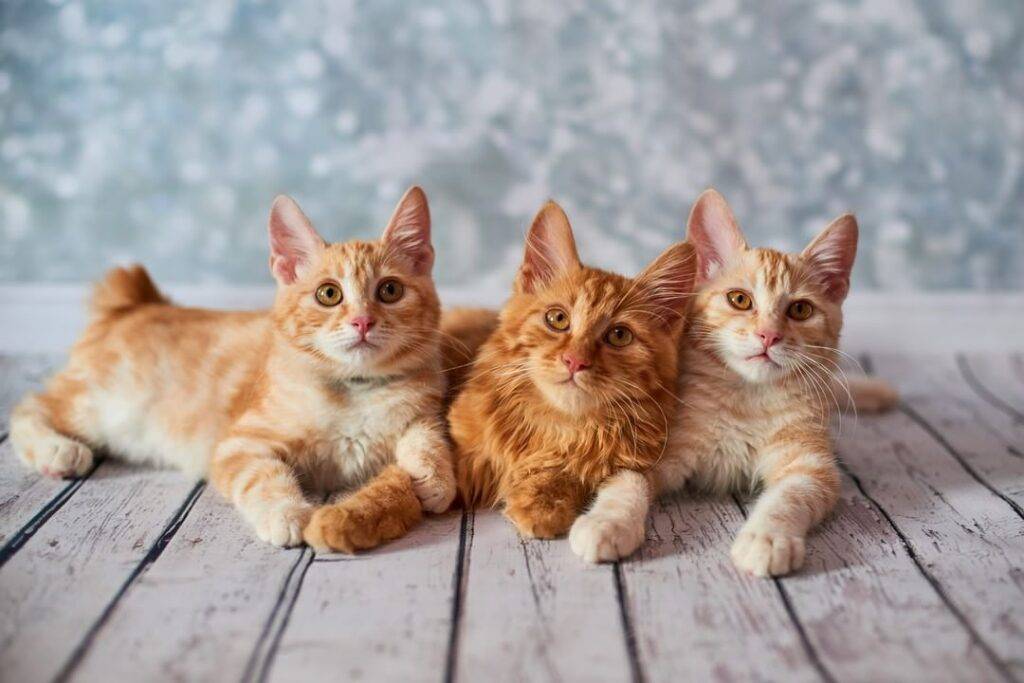
The American Bobtail is one of the most easygoing of the bobtailed breeds: a substantial, semi-longhaired cat with a wild, lynx-like silhouette and a famously short, expressive tail. Behind that rugged, outdoorsy look is a calm, affectionate companion that bonds deeply with its family, gets along with dogs and children, and is so often described as “dog-like” that the comparison has become part of the breed’s identity.
Quick Facts
| Origin | United States |
|---|---|
| Size | Medium to large (males 12–16 lb / 5.4–7.3 kg, females 7–12 lb / 3.2–5.4 kg) |
| Coat | Shorthair or semi-longhair; all colors and patterns |
| Body type | Substantial, muscular, athletic |
| Lifespan | 13–15 years |
| Temperament | Affectionate, intelligent, playful, adaptable |
| Activity level | Moderate |
| Vocalization | Moderate (chirps and trills more than meows) |
| Grooming needs | Moderate |
| Good with children | Yes |
| Good with other pets | Yes |
| Hypoallergenic | No |
| Recognized by | TICA, CFA, WCF |


Appearance
The American Bobtail is a medium-to-large, muscular cat with a powerful, athletic build. Adult males typically weigh 12–16 pounds (5.4–7.3 kg) and females 7–12 pounds (3.2–5.4 kg), with the largest males occasionally pushing close to 20 pounds (around 9 kg). The breed comes in both shorthair and longhair varieties; longhairs carry a particularly impressive shaggy ruff that plays up the wild, untamed look.
The signature feature is, of course, the tail. It runs roughly one-third the length of an ordinary cat’s tail—usually about one to four inches (2.5–10 cm)—and it is flexible and often kinked, knotted, or gently curved. No two are exactly alike. This bobbed tail is a natural dominant genetic mutation, and it is not the same gene that produces the tailless Manx or the pom-pom tail of the Japanese Bobtail. The head is broad and slightly wedge-shaped with a strong brow, large almond-shaped eyes, and medium ears that are frequently tufted, or “lynx-tipped,” at the points.


All colors and patterns are accepted by the major registries, but tabby and tabby-with-white remain the most closely associated with the breed’s wild appearance.
Personality and Temperament
American Bobtails are intelligent, social, and remarkably even-tempered. They tend to land in the middle of the energy spectrum—neither hyperactive nor lazy. A typical Bobtail will happily play, fetch, and shadow you around the house for an hour, then fold into a long lap-nap as if that had been the plan all along.


The breed is best known for its dog-like loyalty. Many Bobtails learn to walk on a harness, play retrieve games, and trot to the door to greet guests. They are talkative but not loud, working through a soft vocabulary of chirps, trills, and clicks rather than the demanding yowl of a Siamese. They form strong attachments to their people and dislike being left alone for long stretches, yet they are usually friendly with strangers and take other cats and dogs in stride.
Because of that steady, sociable temperament, American Bobtails have found a niche as therapy cats and travel companions, and they settle into apartment life easily as long as they get daily interaction.
Health
The American Bobtail is generally a hardy, slow-maturing breed with a typical lifespan of 13–15 years. One of its quirks is just how long that maturation takes: most Bobtails do not reach full adult size until two to three years old.


Reported health concerns in the breed are uncommon. They include occasional hip dysplasia—more often in the larger males—and, much more rarely, partial spinal anomalies tied to the bobtail gene. Because that gene is dominant, responsible breeders are careful about how they pair tailed and bobtailed cats and avoid matings that could produce defective kittens. Hip dysplasia is a heritable orthopedic condition, so it is reasonable to ask any breeder to confirm the hip and spine status of both parents. As with all cats, routine veterinary checkups, parasite prevention, and a healthy weight do far more for longevity than any breed-specific worry. The Cornell Feline Health Center is a reliable, owner-friendly resource for general feline health questions.
Care and Grooming
Grooming needs are moderate. Shorthair Bobtails do well with a brushing about once a week, while longhairs benefit from a twice-weekly session to head off mats, especially around the ruff and the “breeches” on the hind legs. Both coat types shed more heavily with the change of seasons.
Round out that routine by trimming the claws every two to three weeks, checking the ears for wax, and brushing the teeth regularly to support dental health. Like other large, slow-maturing breeds, American Bobtails can put on excess weight if they are free-fed all day, so measured portions and active play sessions go a long way toward keeping body condition in check. The ASPCA’s general cat-care guidance is a good baseline for feeding, grooming, and home setup. These cats enjoy climbing furniture, but they are just as content with floor-level toys and food puzzles that give their problem-solving minds a workout.
History
The breed traces back to a single short-tailed brown tabby kitten named “Yodie,” found by John and Brenda Sanders while vacationing in Arizona in the mid-1960s. Yodie was bred to the Sanders’ female Siamese, and the resulting kittens inherited the short tail. Over the following decades, breeders worked to stabilize a recognizable type, deliberately outcrossing to non-pedigreed domestic cats to keep the gene pool broad and the rugged look intact—and explicitly steering away from a strict resemblance to any single parent breed.


The American Bobtail was accepted for registration by The International Cat Association (TICA) in 1989 and granted full championship status in 2002. The Cat Fanciers’ Association (CFA) followed, advancing the breed through provisional acceptance to championship status, and it is also recognized by the World Cat Federation (WCF).
Interesting Facts
- American Bobtails take two to three years to reach full maturity—far longer than most domestic cats.
- Outcrossing to all-breed and non-pedigreed cats is permitted under the standard, which keeps the breed’s gene pool unusually wide.
- Despite the wild appearance, there is no documented bobcat or lynx ancestry. The look is purely the result of selective breeding from domestic stock.
Frequently Asked Questions
Why does the American Bobtail have such a short tail?
The short tail is the product of a natural dominant genetic mutation that runs in the breed—not the result of docking or injury. Each cat’s tail is a little different, ranging from a short straight stub to a kinked or curved bob roughly one-third the length of a normal cat’s tail. Importantly, it is a different gene from the one behind the tailless Manx or the Japanese Bobtail.
Are American Bobtails hypoallergenic?
No. The American Bobtail is not a hypoallergenic breed, and no cat is truly allergen-free. Cat allergies are usually triggered by the Fel d 1 protein found in saliva and skin, not by hair length, so a Bobtail can still affect allergy-prone households. If allergies are a concern, spend time around the specific cat before bringing one home.
Are American Bobtails good with children and dogs?
Generally, yes. Their calm, sturdy, and sociable nature makes them a good fit for families with respectful children and for homes with cat-friendly dogs. As with any pet, early socialization and supervised introductions help everyone get off on the right paw.
How big do American Bobtails get?
They are a medium-to-large breed. Males commonly weigh 12–16 pounds and females 7–12 pounds, with some of the largest males approaching 20 pounds. Because they mature slowly over two to three years, a young Bobtail may keep filling out well past its first birthday.
Do American Bobtails need a lot of grooming?
Grooming is moderate. Shorthairs are fine with weekly brushing, while longhairs do better with a twice-weekly comb-through to prevent mats, particularly around the ruff and hind-leg breeches. Both types shed seasonally, so brushing tends to increase during those transitions.