
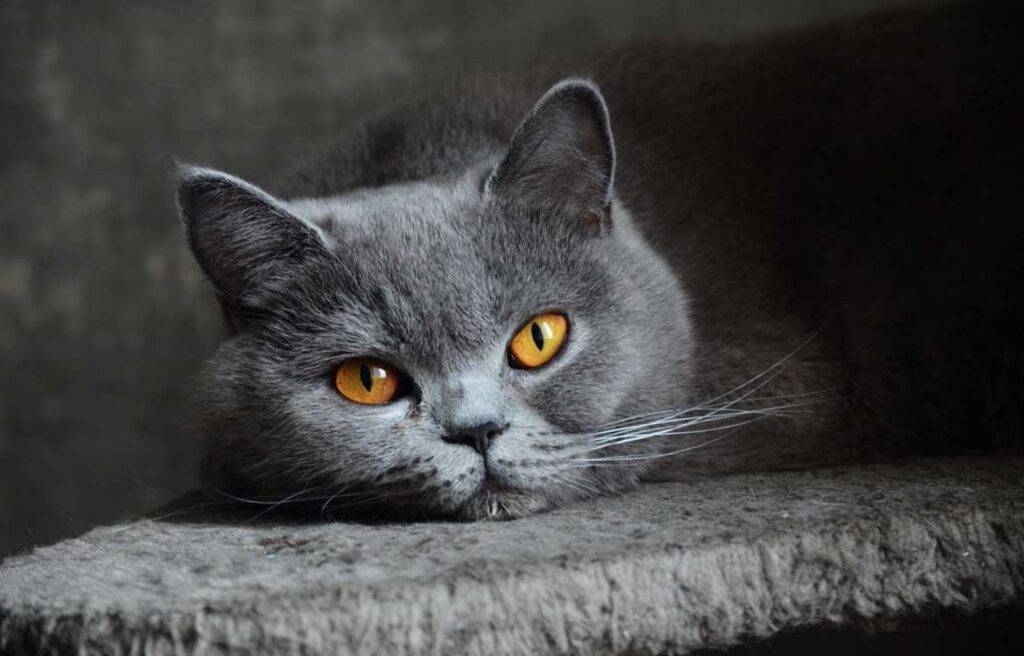
With its plush coat and round, teddy-bear face, the British Shorthair has charmed cat lovers for more than a century. Calm, sturdy, and famously easy-going, this breed is known for its quiet devotion to family, its gentle manners, and the dignified way it shows affection. It settles happily into busy households and gets along with children and other pets alike.
Quick Facts
| Origin | United Kingdom |
|---|---|
| Size | Medium to large (males 12–18 lbs / 5.5–8.2 kg, females 9–13 lbs / 4.0–6.0 kg) |
| Coat | Short and dense; blue (gray) is the most famous, with well over 100 colors and patterns |
| Body type | Cobby and compact |
| Lifespan | 14–20 years |
| Temperament | Calm, affectionate, independent, easy-going |
| Activity level | Low |
| Vocalization | Quiet |
| Grooming needs | Low |
| Good with children | Yes |
| Good with other pets | Yes |
| Hypoallergenic | No |
| Recognized by | TICA, CFA, FIFe, WCF |


Appearance
The British Shorthair is a medium to large cat with a powerful, well-muscled build. Adult males typically weigh between 12 and 18 pounds, while females are smaller at roughly 9 to 13 pounds. The body is cobby and compact, with a broad chest, short sturdy legs, and a thick tail that tapers to a rounded tip.
The head is one of the breed’s most distinctive features: large, round, and broad, with full cheeks that are especially pronounced in mature males, a short straight nose, and a firm chin. The ears are medium-sized, set wide apart, and rounded at the tips. Large round eyes give the British Shorthair its sweet, open expression and come in shades that complement the coat — copper, gold, green, blue, or odd-eyed.
The coat is short, dense, and crisp, with a plush undercoat that gives it a memorable, resilient feel. While the blue (gray) variety is the most iconic, the breed is recognized in well over 100 colors and patterns, including black, white, cream, red, chocolate, lilac, tabby, bicolor, colorpoint, and silver chinchilla.


Personality
The British Shorthair is one of the most easy-going and family-friendly breeds you can bring home. These cats are calm, balanced, and famously good-natured, content to share a household with children, dogs, and other cats without drama. They form strong bonds with their families but tend to show affection in a quietly loyal way rather than by demanding constant attention.


Despite their reputation as couch potatoes, British Shorthairs do enjoy short bursts of play, especially as kittens and young adults. As they mature, they generally settle into a relaxed routine of napping, gentle play sessions, and following their favorite humans from room to room. They are not lap cats in the traditional sense — many prefer to sit beside you rather than on you — but they thrive on companionship and dislike being left alone for long stretches.


British Shorthairs are quiet by nature, with a soft, chirpy voice they use sparingly. They tend to read their owner’s mood well, knowing when to come close for a slow blink and when to retreat to a sunny windowsill. This blend of independence and devotion makes them a popular choice for working households and first-time cat owners alike.
Health
The British Shorthair is generally a hardy, long-lived breed, with most cats reaching 14 to 20 years when kept indoors and given good care. Responsible breeders screen breeding pairs for inherited conditions. The two most important to ask about are hypertrophic cardiomyopathy (HCM), the most common form of heart disease in cats, and hemophilia B, a clotting disorder that can be identified with a simple DNA test. The Cornell Feline Health Center notes that HCM can affect cats of any age and is often silent until advanced, so ask to see parental heart-screening results before purchasing a kitten (Cornell Feline Health Center).


Because of their stocky build and laid-back personality, British Shorthairs gain weight easily, and obesity is one of the most common health issues in the breed. Portion-controlled feeding and regular play are essential to keeping your cat at a healthy weight. Routine vaccinations, parasite prevention, and annual veterinary check-ups round out a solid preventive-care plan (AVMA).
Care
Caring for a British Shorthair is refreshingly straightforward. The dense coat needs only weekly brushing for most of the year, with daily combing during the spring and fall molts to control shedding and prevent hairballs. Bathing is rarely necessary.
Diet is the area that needs the most attention. Feed a high-quality, age-appropriate cat food in measured portions, and avoid free-feeding once your cat reaches adulthood. Provide fresh water, a sturdy scratching post, and a few interactive toys to keep your cat mentally engaged. Cat trees and window perches are appreciated even by less athletic cats — a British Shorthair may not leap to the top of the bookcase, but it still enjoys a good vantage point. The ASPCA offers helpful general guidance on day-to-day feeding, grooming, and enrichment (ASPCA).
Trim the claws every two to three weeks, brush the teeth regularly, and clean the ears as needed. The breed is people-oriented and adapts well to apartment life, but always provide safe indoor enrichment so your cat doesn’t become bored or sedentary.
History
The British Shorthair is one of the oldest natural cat breeds in the Western world. Its ancestors are thought to have arrived in Britain with the Romans, who brought sturdy farm cats to keep grain stores free of rodents. Over the centuries, these working cats interbred with native felines and developed the dense, weatherproof coat and rugged constitution still seen today.


Selective breeding began in earnest in the late nineteenth century, when British cat fancier Harrison Weir championed the native shorthair as a show breed. Cats of this type were exhibited at the very first organized cat show, held at London’s Crystal Palace in 1871, and the breed gained official recognition in 1898. Both World Wars devastated breeding stock, and after 1945 breeders carefully outcrossed survivors to Persians and other shorthairs to rebuild the gene pool — a step that gave the modern British Shorthair its rounder features and broader head.
The breed was officially recognized by the Cat Fanciers’ Association in 1980 and is now accepted by every major international registry. Today the British Shorthair is among the most popular pedigreed cats in the world, prized for its calm temperament, photogenic looks, and reputation as a steady, undemanding companion (CFA).


Frequently Asked Questions
Are British Shorthairs good family pets?
Yes. British Shorthairs are calm, patient, and good-natured, which makes them well suited to households with children and other animals. They tolerate gentle handling and busy homes without becoming stressed, and they generally get along with dogs and other cats when properly introduced.
Do British Shorthairs like to be held?
Most British Shorthairs are affectionate but not especially fond of being carried or held for long. They tend to show their devotion by staying close and sitting beside you rather than curling up in your lap. This independent style of affection is one of the things owners love about the breed.
How much grooming does a British Shorthair need?
Grooming needs are low. A weekly brushing keeps the dense coat healthy for most of the year, with more frequent combing during the heavier spring and fall shedding seasons. Bathing is rarely required, making this an easy breed to maintain.
How long do British Shorthairs live?
With good care, a balanced diet, and an indoor lifestyle, British Shorthairs commonly live 14 to 20 years. Keeping your cat at a healthy weight and scheduling annual veterinary check-ups are two of the best ways to support a long, comfortable life.
Are British Shorthairs hypoallergenic?
No. No cat breed is truly hypoallergenic, and the British Shorthair’s dense double coat does shed. People with cat allergies should spend time around the breed before bringing one home.