
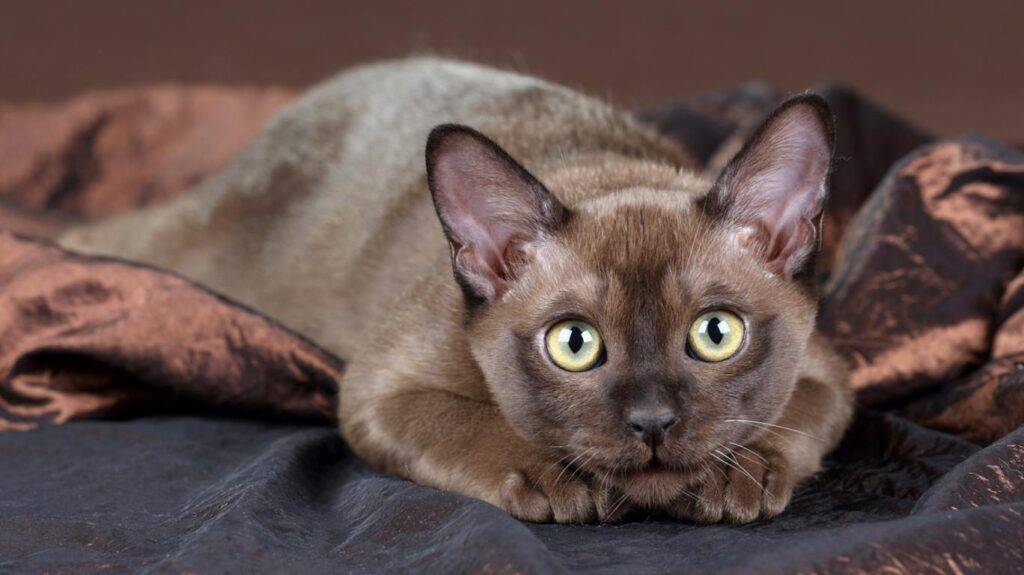
Devoted, social, and famously affectionate, the Burmese is often called the “cat-dog” of the feline world. Behind that doglike loyalty is a sleek, graceful animal with the elegance and self-assurance of a true pedigree.
Quick Facts
| Origin | Burma (Myanmar) and the United States |
|---|---|
| Size | Medium (males 10–14 lb / 4.5–6.4 kg, females 8–11 lb / 3.5–5.0 kg) |
| Coat | Short and satiny; sable, champagne, blue, and platinum |
| Body type | Compact and muscular (semi-cobby) |
| Lifespan | 16–18 years, sometimes into the early twenties |
| Temperament | Affectionate, vocal, playful, people-oriented |
| Activity level | High |
| Grooming needs | Low |
| Good with children | Yes |
| Good with other pets | Yes, with slow introductions |
| Hypoallergenic | No |
| Recognized by | CFA, TICA, FIFe, WCF |
Key Takeaways
- The Burmese is one of the most people-focused cat breeds, thriving on company and poorly suited to long hours alone.
- Its short, satin-like coat needs only a weekly brushing, making the breed remarkably low-maintenance to groom.
- Two types exist: the rounder American (Contemporary) Burmese and the more moderate British (European) Burmese.
- Most live 16 to 18 years, but the breed carries a few inherited risks, so choose a breeder who screens their cats.
Appearance


The Burmese is a medium-sized cat with a deceptively heavy, muscular build. Breeders like to describe the breed as “a brick wrapped in silk,” and the phrase fits: lift one and you will be surprised by how solid it feels. Adults typically weigh between 8 and 14 pounds (about 3.5 to 6.5 kg), with males noticeably stockier than females. Two distinct types are recognized today—the rounder, more compact American (or Contemporary) Burmese, and the slightly longer, more moderate British (or European) Burmese.
American Burmese have a broad, rounded skull, full cheeks, and a short muzzle, set on a sturdy semi-cobby body. The British type is a touch more elegant, with a gently wedge-shaped head and a slightly longer body, though it is still shorter and rounder than an Oriental or Siamese.
The eyes are large, expressive, and set wide apart—traditionally a vivid golden yellow that can deepen to amber. The ears are medium-sized and gently rounded at the tips, and the tail is straight and of medium length, tapering smoothly to a rounded point.


The coat is short, fine, and remarkably glossy, lying close to the body with almost no undercoat; many owners compare the texture to satin. The color is subtly shaded—darker on the points (face, ears, legs, and tail), medium across the back and sides, and lightest on the belly. The four classic colors recognized in the United States are sable (a rich brown), blue, champagne (chocolate), and platinum (lilac). European registries also recognize red, cream, and tortoiseshell variants.
Personality
The Burmese has earned its “cat-dog” nickname honestly. Few breeds are as openly attached to their people. A Burmese will follow you from room to room, supervise every household chore, and claim the nearest lap the moment one opens up. They are vocal but never strident, offering gentle, conversational meows in reply to almost anything you say.
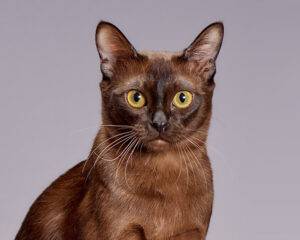

Burmese stay playful well into adulthood, keeping a kittenish enthusiasm for fetch, puzzle toys, and shoulder-riding long after most breeds have settled down. They are sociable with children and generally welcoming toward dogs, but their strong personalities mean they may try to dominate other cats, so introductions to existing pets should be made slowly. Loneliness is the breed’s greatest enemy: a Burmese left alone all day will often pine. Households where someone is usually home—or where a second sociable cat can keep them company—suit them best.
Health


The Burmese is an old, generally robust breed, with most cats living 16 to 18 years and many reaching their early twenties when well cared for. There are, however, a few inherited conditions worth knowing about. Burmese hypokalemia—low blood potassium that causes episodes of muscle weakness—has a recognized genetic test, and a DNA screen for the disorder lets responsible breeders clear their lines. Diabetes mellitus is also reported in the breed, and feline diabetes is more likely in overweight cats, so it pays to keep your Burmese lean and feed a measured, protein-rich diet (see the Cornell Feline Health Center for more on managing weight and blood sugar). The Contemporary American type can carry a craniofacial deformity gene, which ethical breeders avoid by testing both parents before mating.
Whatever line you choose, ask to see the parents’ health-test results before you commit to a kitten. A reputable breeder will offer them without hesitation.
Care
From a coat-care standpoint, the Burmese is one of the most low-maintenance pedigrees you can own. A weekly once-over with a soft rubber brush or grooming mitt is enough to lift loose hair and keep the satin sheen at its best, and bathing is rarely needed. Beyond grooming, the basics apply: a high-quality diet, fresh water, annual veterinary checkups, year-round parasite prevention, and up-to-date vaccinations. Because the breed thrives on company, plan for plenty of interactive play and climbing furniture—and ideally a feline companion if the house is empty during the workday.
History
The Burmese traces its modern story to a single small brown cat named Wong Mau, brought from Burma to San Francisco in 1930 by Dr. Joseph Thompson. Wong Mau was bred to a seal-point Siamese, and her offspring crossed back to her produced the first solid sable kittens that founded the breed. The Cat Fanciers’ Association recognized the Burmese in 1936. A separate British type developed later with a slightly more moderate body, and the breed has been instrumental in creating several others, including the Bombay, Burmilla, and Tonkinese.
Frequently Asked Questions
Are Burmese cats good for first-time owners?
Yes—their easygoing, affectionate nature and minimal grooming needs make Burmese a forgiving choice for new cat owners. The one real condition is time and attention: this is not a breed that does well left alone all day, so they suit people who are home often or who can provide a companion animal.
Do Burmese cats shed a lot?
Not really. The short, single-layer coat has almost no undercoat, so shedding is light compared with most breeds. A weekly brushing keeps loose hair under control. That said, the Burmese is not hypoallergenic; no cat truly is, since the main allergen comes from saliva and skin rather than fur.
How long do Burmese cats live?
Burmese are a long-lived breed. Most reach 16 to 18 years, and well-cared-for cats from health-screened lines often make it into their early twenties.
Are Burmese cats vocal?
They are talkative but far softer than their Siamese relatives. Expect a steady stream of gentle, conversational meows rather than loud yowling—most owners find the chatter endearing rather than disruptive.
Do Burmese cats get along with dogs and other pets?
Generally yes. Their confident, sociable temperament makes them comfortable around dogs and children. With other cats, their take-charge personality means introductions should be made slowly and on neutral ground to avoid one cat trying to dominate the other.