
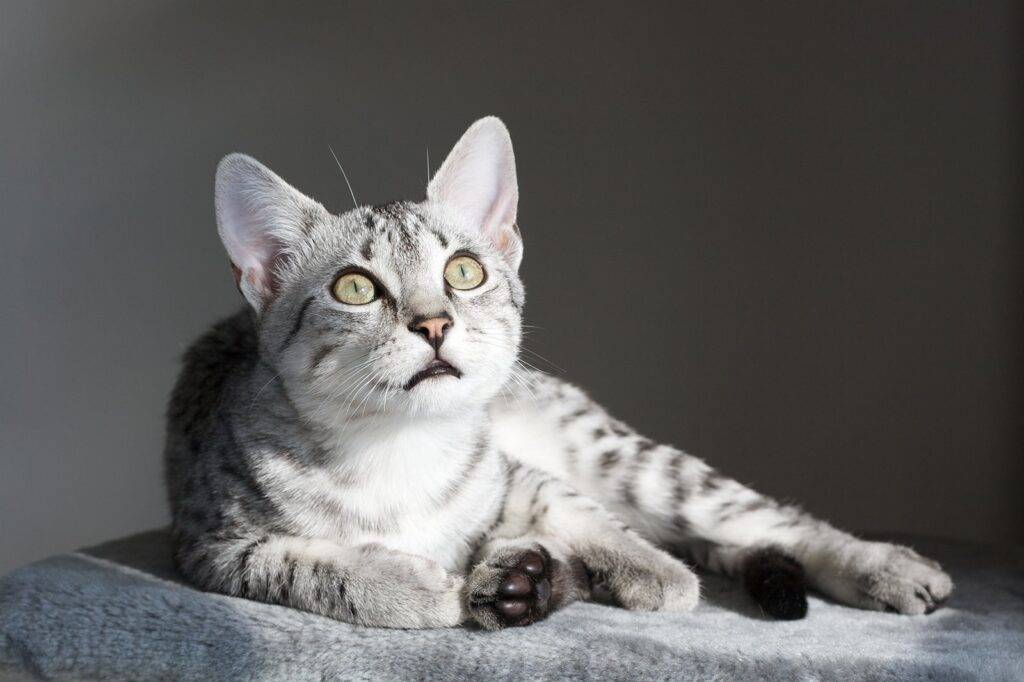
Gentle and devoted with the people it knows, the Egyptian Mau brings a calm, home-loving presence to the household. It bonds closely with its owner, gets along well with children, and forms genuine friendships with other family pets—all in a notably soft, pleasant voice.
Quick Facts
| Origin | Egypt |
|---|---|
| Size | Medium (males 9–13 lb / 4.0–6.0 kg; females 7–11 lb / 3.0–5.0 kg) |
| Coat | Short, naturally spotted; silver, bronze, or smoke |
| Body type | Semi-foreign |
| Lifespan | 12–15 years |
| Temperament | Active, loyal, athletic, reserved with strangers |
| Activity level | High |
| Vocalization | Moderate |
| Grooming needs | Low |
| Good with children | Yes |
| Good with other pets | Moderate |
| Hypoallergenic | No |
| Recognized by | TICA, CFA, FIFe, WCF |


Appearance
The Egyptian Mau is a medium-sized cat with a semi-foreign build that recalls the Abyssinian in outline. Males typically weigh 9 to 13 pounds and females 7 to 11 pounds, so most adults top out around 11 pounds. The bones are strong and the muscles well developed, yet the overall silhouette stays graceful and balanced rather than heavy.
The forelegs are slightly shorter than the hind legs—a subtle structural feature that gives the breed its distinctive elevated stance and contributes to its remarkable speed. The Mau is widely regarded as the fastest of the domestic cat breeds, capable of short bursts that few other cats can match. The paws are small, oval, and compact. The neck is strong and gently arched, and the head forms a slightly rounded wedge with a smooth transition from forehead to muzzle. Mature males develop fuller cheeks. The eyes are large and almond-shaped, set with a slight slant; kittens are born with amber eyes that gradually shift to a clear gooseberry green by about 18 months.


The ears are medium to large with slightly pointed tips, and lynx tufts on the inside are welcomed by the standard. The tail is medium in length and tapers gently to the tip.
The coat is short, silky, and finely ticked, and the only accepted pattern is spotted tabby—the Egyptian Mau is the only naturally spotted domestic cat breed. A characteristic “M” marking sits on the forehead, ringed bands run along the tail, and a clear “necklace” crosses the upper chest. Spots appear on three recognized ground colors: silver, bronze, or smoke. Outcrossing to other breeds is not permitted.


Personality and Temperament
The Egyptian Mau is active, playful, and observant, but it pairs that energy with a quietly dignified manner. Within the family it can romp like a kitten, while strangers are usually met with a polite, watchful reserve until trust is earned.
With the people it loves, the breed is genuinely affectionate and home-oriented. It tends to choose one or two favorite humans and follow them from room to room. It also gets along well with other household pets, including dogs that respect the cat’s space, and the voice it uses to chat with its family is famously soft and musical rather than insistent. Many Maus also “chortle” or wiggle their tails when excited, a charming quirk owners come to know well.
Temperamentally the Mau is balanced and not aggressive, but it is sensitive. Loud, chaotic environments and frequent change can stress it. A calm household with predictable routines, plenty of vertical climbing space, and regular interactive play will bring out the breed’s confident, athletic side.


Health
The Egyptian Mau is generally a hardy, long-lived breed, with a typical lifespan of 12 to 15 years. Conditions occasionally reported in the breed include heart disease—most notably hypertrophic cardiomyopathy (HCM), the most common form of heart disease in cats—along with feline asthma, and a small number of lines have produced pyruvate kinase deficiency. Hypertrophic cardiomyopathy causes the heart muscle to thicken and can lead to heart failure or blood clots, which is why responsible breeders screen their cats before breeding (Cornell Feline Health Center).
Reputable breeders screen breeding cats for HCM and pyruvate kinase deficiency and guarantee against early-onset hereditary disease, so always ask to see the parents’ test results before bringing home a kitten. Yearly veterinary check-ups, parasite prevention, and a consistent vaccination schedule round out a sensible health routine (ASPCA).
Care and Grooming
Day-to-day care is straightforward. The Egyptian Mau adapts well to apartment life, but a home with a secure garden or a generous catio is closer to ideal—this is a born hunter that loves to investigate every leaf, branch, and beetle. Because the breed is sociable and bonds tightly with its people, it does not cope well with long stretches of solitude; if the household is empty most of the day, a feline companion is worth considering.
Grooming is minimal. A brisk weekly brushing with a soft-bristled brush or grooming mitt is enough to keep the silky coat glossy and remove loose hair. Check the ears, claws, and teeth on the same weekly schedule. Feed a high-quality, protein-forward diet portioned to the cat’s active lifestyle, and provide plenty of climbing trees, puzzle feeders, and chase toys to satisfy its strong prey drive.

History
The breed’s native country is Egypt, and its roots reach deep into antiquity. In the language of the ancient Egyptians, “mau” meant simply “cat.” Spotted cats closely resembling today’s Mau appear in tomb paintings and papyri dating back more than three thousand years, when felines were revered both as household companions and as protectors against misfortune.
The modern breed’s revival began in the mid-20th century, when exiled Russian princess Nathalie Troubetskoy acquired silver Mau cats while living in Italy and brought them with her when she emigrated to the United States in 1956. Her foundation imports became the basis of the breed’s North American development, and her early show entries drew enthusiastic attention from breeders and judges alike.
The Cat Fanciers’ Association first recognized the Egyptian Mau in 1968 (CFA). A revised breed standard followed in 1988, and the Fédération Internationale Féline added the Mau to its register in 1992. Today the breed is recognized by all major international registries and remains the only naturally spotted pedigreed domestic cat.


Frequently Asked Questions
Are Egyptian Maus good family cats?
Yes. The Egyptian Mau is affectionate and loyal with the people it knows, gets along well with respectful children, and can form genuine bonds with other cats and even dogs. It does bond closely and dislikes being left alone for long periods, so it suits households where someone is around for much of the day, or where a second pet keeps it company.
Are Egyptian Maus hypoallergenic?
No. No cat breed is truly hypoallergenic. Cat allergies are triggered mainly by the Fel d 1 protein found in saliva and skin rather than by the length of the coat, so even a short-haired, low-shedding breed like the Mau can affect allergy sufferers.
How fast can an Egyptian Mau run?
The Egyptian Mau is often described as the fastest of the domestic cat breeds. Its slightly longer hind legs and a loose flap of skin along the belly give it an unusually long stride, and short sprints are commonly cited at well over 30 miles per hour.
Do Egyptian Maus need a lot of grooming?
No. The short, silky coat is low-maintenance. A weekly brushing to remove loose hair, along with routine ear, nail, and dental care, is all most Maus require to stay in excellent condition.
How much does an Egyptian Mau cost?
Because the breed is relatively uncommon and breeders maintain a small, carefully screened gene pool, pedigreed kittens from a reputable breeder typically command a premium price. Always prioritize a breeder who health-tests their breeding cats over the lowest available price.