
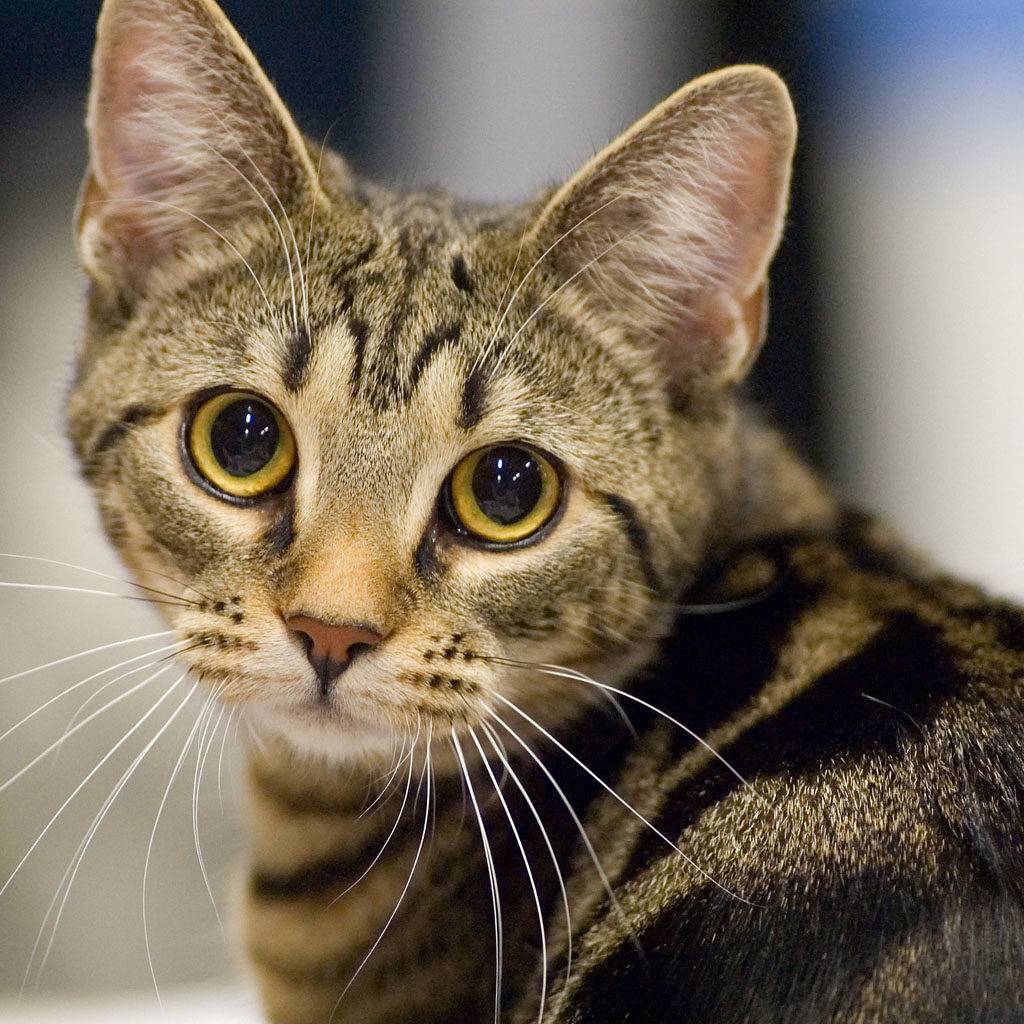
The European Shorthair is one of those rare cats that seems to fit any household. Playful and good-humored, yet calm and remarkably well-mannered, it settles into family life with very little fuss and often becomes the steady, easygoing presence the rest of the home revolves around.
Quick Facts
| Origin | Continental Europe |
|---|---|
| Size | Medium (males 10–15.5 lb / 4.5–7.0 kg; females 7.5–13 lb / 3.5–6.0 kg) |
| Coat | Short; nearly all colors and patterns |
| Body type | Substantial, muscular |
| Lifespan | 15–20 years |
| Temperament | Calm, independent, friendly, adaptable |
| Activity level | Moderate |
| Vocalization | Quiet |
| Grooming needs | Low |
| Good with children | Yes |
| Good with other pets | Yes |
| Hypoallergenic | No |
| Recognized by | FIFe, WCF |
Appearance


The European Shorthair is a medium-sized cat that can reach roughly 17 pounds (about 8 kg) at the larger end of the range. The body is long and powerfully built, carried on sturdy legs of moderate length, with strong muscles and a thick neck. The head is broad and rounded, with well-developed cheeks that are especially pronounced in toms, and the line from forehead to muzzle slopes gently rather than breaking sharply.


The eyes are large and round, set wide apart and slightly slanted, with a color that typically harmonizes with the coat. The ears are medium-sized with rounded tips, occasionally finished with small tufts of hair. The tail is of moderate length, fairly thick at the base, and tapers gradually to a rounded tip.
The coat is short, dense, and resilient, backed by a soft undercoat that gives the breed its weatherproof feel. Almost every color and pattern is accepted, with the notable exceptions of colorpoint and lilac.


Personality
The European Shorthair makes a wonderful family pet. Its lively, cheerful temperament is balanced by an unusually steady, cooperative streak, which makes these cats easy to raise and quick to slot into a household with very little disruption.


Affectionate and outgoing without being demanding or clingy, the European Shorthair will happily follow you from room to room, but it is just as content to entertain itself with a quiet game or a sunny windowsill. That independence is part of what makes the breed so low-stress to live with.
It suits families with children and other animals exceptionally well. Good-natured “Europeans” make friends easily and bond closely with their people, returning attention with steady devotion. Just don’t mistake this cat for a sofa ornament: it keeps a strong hunting instinct and will be genuinely grateful for the chance to patrol a fenced garden or a secure catio. Because free-roaming carries real risks to both cats and local wildlife, the ASPCA and most veterinary groups recommend keeping cats indoors or in enclosed outdoor spaces. (ASPCA)
Health


The European Shorthair enjoys generally robust health, with an average lifespan of around 15 years and many individuals living comfortably into their late teens or even early twenties. Because the breed was developed from a broad genetic base of European working cats rather than a narrow founder pool, it isn’t strongly tied to any single inherited disorder.
That said, responsible care still matters. Stay current on annual veterinary check-ups, core vaccinations, and parasite prevention. Keep an eye on the routine concerns that affect most domestic cats — dental disease, obesity, urinary tract problems, and age-related kidney decline — and tackle weight gain early through portion control and active play. Obesity in particular is one of the most common and preventable health problems in pet cats, and it raises the risk of diabetes, joint disease, and other conditions. (Cornell Feline Health Center)
Care
The European Shorthair is famously low-maintenance. Its dense short coat needs only a once-weekly brushing to lift loose hair and keep the undercoat tidy, though more frequent grooming helps during the spring and autumn shedding seasons. Bathing is rarely necessary unless your cat has gotten into something genuinely messy.
Beyond the coat, care is straightforward. Trim the claws every two to three weeks, check the ears and clean them gently whenever you notice wax buildup, and brush the teeth regularly to head off periodontal disease. Feed a balanced, age-appropriate diet, keep fresh water available at all times, and provide plenty of climbing surfaces, scratching posts, and interactive toys to satisfy the breed’s curiosity and moderate energy. Routine at-home dental care, paired with professional cleanings as your veterinarian advises, is one of the simplest ways to protect long-term health. (AVMA)
History


The European Shorthair is essentially a refined version of the working cats that have lived alongside people across continental Europe for centuries — animals with sound conformation, hardy constitutions, and a wide range of natural colors. Breeders set out to formalize those qualities into a recognized pedigree, in part by carefully crossing native European cats with British Shorthair and American Shorthair lines to standardize type without sacrificing the breed’s everyday vigor.
The first written breed standard appeared in 1925. For many decades the European Shorthair was treated as a regional variation of the British Shorthair; the two were officially separated in 1982, when the Fédération Internationale Féline (FIFe) recognized the European Shorthair as a distinct breed in its own right. The breed is also accepted by the World Cat Federation and remains especially popular across the Nordic countries, where it is prized as a sturdy, even-tempered family cat. (FIFe)


Frequently Asked Questions
Is the European Shorthair the same as a common house cat?
Not quite. While the breed descends from the ordinary working and house cats of continental Europe, the pedigreed European Shorthair is a standardized breed with a written standard and registry recognition (FIFe and the WCF). A random short-haired cat from a shelter may look similar but is technically a domestic shorthair rather than a pedigreed European Shorthair.
How is the European Shorthair different from the British Shorthair?
The two breeds share history and were considered the same for decades, but they were officially separated in 1982. The British Shorthair tends to be rounder, stockier, and more heavy-boned, while the European Shorthair has a slightly longer, more athletic build and a less extreme head shape. Their temperaments are similarly calm and friendly.
Is the European Shorthair good with children and other pets?
Yes. The breed is known for its even, good-natured temperament and adapts well to busy households. European Shorthairs generally get along with respectful children and with other cats and dogs, especially when introductions are made gradually.
Does the European Shorthair require a lot of grooming?
No. The short, dense coat needs only a weekly brushing for most of the year, with a bit more attention during seasonal shedding. Routine claw trims, ear checks, and regular tooth brushing round out an easy care schedule.
How long do European Shorthairs live?
With good care, these cats commonly live 15 to 20 years. Their broad genetic background means they aren’t strongly linked to a single inherited disease, though they still benefit from regular veterinary care, parasite prevention, and weight management.