
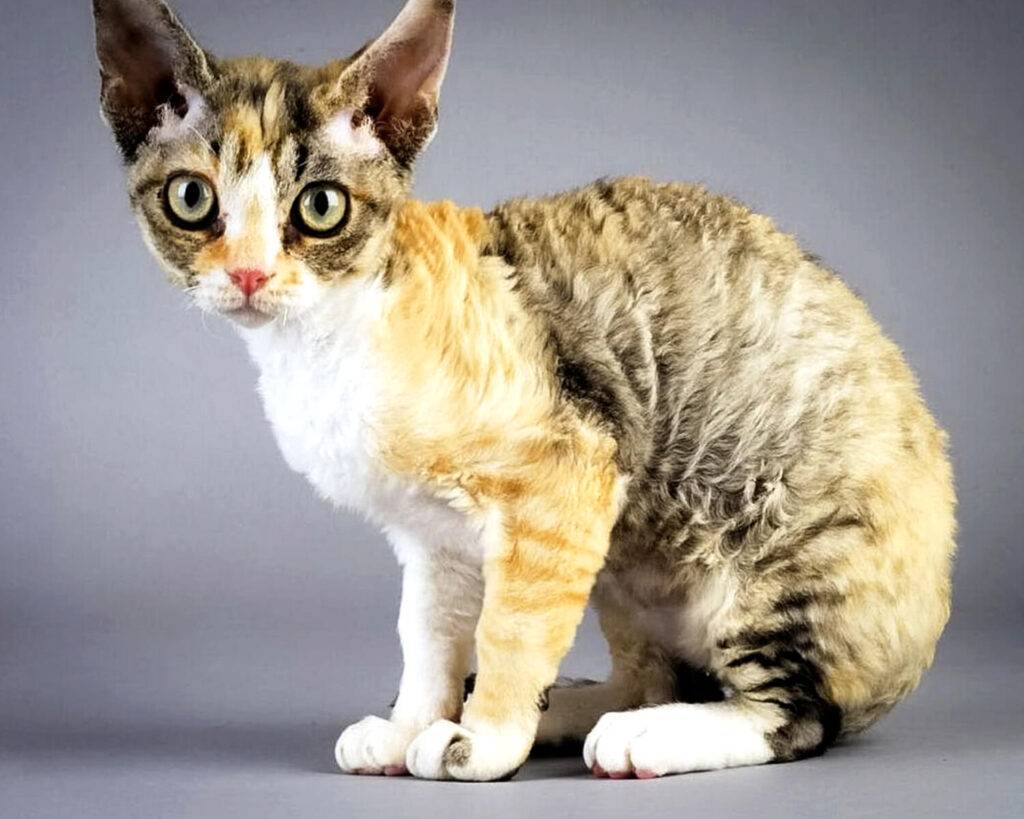
The German Rex is a well-balanced, medium-sized cat with a soft, curly coat and a friendly, easygoing nature. Closely related to the Devon Rex and Cornish Rex, it shares many of their qualities while standing apart as the oldest of the curly-coated cat breeds — and one of the rarest in the world today.
Quick Facts
| Origin | Germany |
|---|---|
| Size | Medium (males 7.5–11 lb / 3.5–5.0 kg, females 5.5–9 lb / 2.5–4.0 kg) |
| Coat | Short, curly; most colors and patterns |
| Body type | Semi-foreign |
| Lifespan | 9–14 years (often longer with good care) |
| Temperament | Affectionate, playful, intelligent, sociable |
| Activity level | Moderate |
| Vocalization | Moderate |
| Grooming needs | Low |
| Good with children | Yes |
| Good with other pets | Yes |
| Hypoallergenic | No (sheds less, but not allergen-free) |
| Recognized by | FIFe, WCF |
Appearance


The German Rex is a medium-sized cat with a plush, lamb-like coat and large, expressive eyes that give the breed its trademark soft expression. The body is muscular and surprisingly powerful for its size, yet it stays slim and graceful — an athletic build that never looks heavy or massive.


The head is rounded, with well-developed cheeks and a short muzzle that is slightly longer than the Cornish Rex’s. Medium-sized ears sit high on the head with gently rounded tips, and the eyes are large, round, and colored to complement the coat. The tail is medium in length, well covered with curly hair, and tapers to a rounded tip, while the legs are long and slender with neat, oval paws.
The coat is the breed’s defining feature. It is short, soft, and silky to the touch, with even waves or curls covering the entire body. Even the whiskers and eyebrows are curled or crimped. Most colors and patterns are accepted by the registries that recognize the breed, although some — such as chocolate, lilac, and colorpoint — are excluded under several standards.
Personality


The German Rex is often described as having a near-perfect personality, striking an unusual balance: lively yet calm, affectionate yet independent, playful yet gentle. These cats stay kitten-like well into adulthood and love interactive games, puzzle toys, and time spent with their people.
They are quick learners, and many can be taught to fetch, walk on a harness, or perform simple tricks. At the same time, they are self-sufficient enough to entertain themselves when their owners are busy, without becoming destructive or anxious.


The German Rex is patient and rarely sulks if attention is in short supply for a few hours. Even so, this is a deeply social breed that should not be left alone for long stretches every day; prolonged isolation can leave it withdrawn or restless. These cats tend to bond closely with the whole household rather than fixating on a single person.
Friendly and good-natured, German Rexes generally get along well with respectful children, with other cats, and with cat-friendly dogs.


Health
On the whole, the German Rex is a robust, healthy breed with no widespread, breed-specific disorders. With a balanced diet, regular veterinary care, and an indoor lifestyle, many cats live 12 to 15 years or more.
Owners should still keep an eye on the issues common to curly-coated cats: occasional skin irritation, sensitivity to cold drafts because of the thin coat, and dental disease if oral care is neglected. Periodontal disease is one of the most common conditions in adult cats, so regular dental care matters for any breed (Cornell Feline Health Center). As with any cat, sourcing a kitten from a responsible breeder who screens the parent cats and provides early veterinary care helps reduce the risk of inherited problems.
Care
Caring for a German Rex is refreshingly simple. Because the coat lacks a heavy undercoat, grooming is minimal — a gentle brushing or a wipe with a soft grooming mitt once a week is enough to keep the curls in good condition and remove loose hair. Avoid stiff slicker brushes, which can damage the delicate waves. Bathe only when necessary, using a mild cat shampoo, and dry the cat thoroughly afterward to prevent chilling.
A simple weekly routine keeps the rest of the coat and body in good shape:
- Check the ears weekly and clean them gently with a vet-approved solution only if you see dirt or wax.
- Trim the claws every two to three weeks.
- Brush the teeth regularly with a cat-specific toothpaste, and ask your vet about professional dental cleanings.
The German Rex has a stocky build and a healthy appetite, which makes it prone to weight gain if portions are not controlled. Because excess weight is linked to diabetes, joint problems, and other health issues in cats, keeping your cat lean is one of the best things you can do for its long-term health (ASPCA). Feed a measured, complete diet suited to your cat’s age and activity level, provide fresh water at all times, and limit treats. Routine veterinary visits, core vaccinations, and parasite prevention round out the care plan.
History


The German Rex is the oldest of the curly-coated cat breeds. The earliest documented curly-coated cat in Germany was a black female named Munk, born around 1930 in the former East Prussia — but it was a stray cat in Berlin that gave rise to the modern breed.
In 1951, Dr. Rose Scheuer-Karpin discovered a curly-coated black cat on the grounds of a Berlin hospital and named her Lämmchen, meaning “little lamb.” Lämmchen became the foundation of the breed. Her descendants were later crossed with Cornish Rex cats, and the curly trait was shown to be inherited as a recessive gene distinct from the Cornish Rex mutation.
The German Rex was officially recognized by the Fédération Internationale Féline (FIFe) in 1951 and is also recognized by the World Cat Federation (WCF). The Cat Fanciers’ Association (CFA) does not currently recognize it as a separate breed. Despite a small but devoted following in Europe, the German Rex remains one of the rarest pedigreed cats in the world.
Frequently Asked Questions
Is the German Rex hypoallergenic?
No. The German Rex sheds less than many cats because of its thin, undercoat-free coat, which some allergy sufferers tolerate better. However, no cat breed is truly hypoallergenic. Cat allergies are usually triggered by Fel d 1, a protein found in saliva and skin that spreads to the coat during grooming, so even a low-shedding curly cat still produces allergens (ASPCA).
What is the difference between the German Rex, Cornish Rex, and Devon Rex?
All three are curly-coated breeds, but they arose from separate genetic mutations and have distinct looks. The German Rex is the oldest and has a rounded head with a medium, plush coat. The Cornish Rex has a more wedge-shaped head, an arched body, and a very short, tightly waved coat. The Devon Rex is known for its large, low-set ears, pixie-like face, and looser curls. The German Rex’s curly gene is recessive and separate from the Cornish Rex mutation.
Are German Rex cats rare?
Yes. Despite a long history and a loyal following in Europe, the German Rex remains one of the rarest pedigreed cats in the world. Outside of Europe it is very uncommon, and the Cat Fanciers’ Association does not currently recognize it as a separate breed.
Are German Rex cats good with children and other pets?
Generally, yes. German Rexes are friendly, patient, and sociable. They usually do well with respectful children, other cats, and cat-friendly dogs, especially when introductions are made gradually and the cat has quiet spaces to retreat to.