
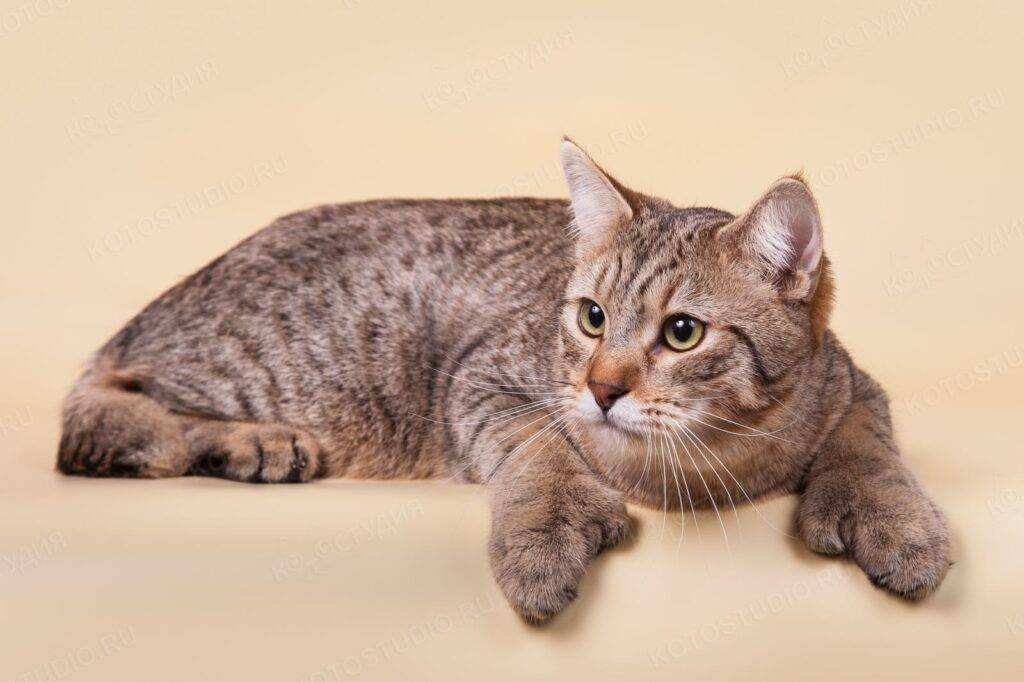
With the rugged look of a North American bobcat and the heart of a devoted lap cat, the Pixiebob is a striking yet wonderfully easygoing companion. It may look like it just trotted in from the forest, but this breed is thoroughly domestic and forms deep, lasting bonds with its people.


Quick Facts
| Origin | United States |
|---|---|
| Size | Large (males 12–22 lb / 5.5–10 kg; females 8–14 lb / 3.5–6.5 kg) |
| Coat | Short or semi-long; brown spotted tabby only |
| Body type | Substantial and muscular |
| Lifespan | 13–16 years |
| Temperament | Loyal, intelligent, calm, dog-like |
| Activity level | Moderate |
| Vocalization | Quiet |
| Grooming needs | Low |
| Good with children | Yes |
| Good with other pets | Yes |
| Hypoallergenic | No |
| Recognized by | TICA, WCF |
Appearance
The Pixiebob is a substantial, athletic cat that bears a remarkable resemblance to its wild cousins of the North American woods. Mature males typically weigh between 12 and 22 pounds, while females are smaller at roughly 8 to 14 pounds, giving the breed an imposing but well-proportioned frame.
The body is long, strong, and muscular, set on sturdy legs and finished with notably large paws. The head is broad with a long, wide muzzle, and the oval eyes are usually shaded to harmonize with the coat. The ears sit wide at the base, round off at the tips, and ideally carry lynx-like tufts. The signature bobbed tail is short, thick, and flexible, completing the breed’s wild silhouette.
The coat comes in two lengths, short or semi-long. Either way it is dense and weather-resistant, with a plush gray undercoat that keeps the cat warm in cold conditions. The only accepted color is brown spotted tabby, with clearly defined ticking and markings.
One of the breed’s most distinctive traits is polydactyly, or extra toes. Many Pixiebobs are born with six or seven toes on the front paws and up to six on the back, and this trait is fully accepted in the breed standard rather than treated as a fault.
Personality


For all its untamed looks, the Pixiebob is an exceptionally affectionate and easygoing companion. The breed is known for a sweet, friendly disposition and an unflappable, even temperament that rarely ruffles.
Pixiebobs bond with the whole household, children and other pets included, though most will single out one favorite person. They tend to recognize that person anywhere, greeting them at the door and trailing them from room to room. Many owners describe the breed as dog-like in its loyalty and its knack for slotting into the family’s daily routine.
Calm does not mean couch-bound. The Pixiebob is athletic and genuinely playful, happy to chase an interactive toy, scale a cat tree, or even learn to walk on a leash. Regular play sessions channel that energy and keep these intelligent cats mentally engaged, so plan on giving yours plenty of room to run and a few good toys to work for.
Health


The Pixiebob is generally a hardy breed with a typical lifespan of 13 to 16 years. Careful breeding has kept the gene pool sound, and most cats enjoy long, active lives.
Polydactyly is common and is regarded as a normal feature of the breed rather than a defect; it does not affect a cat’s show eligibility or its everyday quality of life. As with many pedigreed cats, however, occasional cases of hypertrophic cardiomyopathy (HCM), cryptorchidism, and distichiasis have been reported. HCM is the most common form of heart disease in cats, so buying from a breeder who screens breeding stock for hereditary conditions is the single best safeguard (Cornell Feline Health Center). Routine veterinary checkups also help catch any concerns early (AVMA).
Care
Day-to-day care for a Pixiebob is refreshingly straightforward. Brush the coat about once a week to lift out loose hair and keep the undercoat in good shape; semi-long-coated cats may appreciate a little extra attention during seasonal shedding.
Trim the claws regularly and check the ears, cleaning them as needed. Because of their stocky build, Pixiebobs put on weight easily, so keep an eye on portion sizes and treats and pair sensible feeding with plenty of active play. Round things out with routine vaccinations and year-round parasite prevention, the same preventive basics recommended for any house cat (ASPCA).
History


The Pixiebob traces back to a Washington State breeder named Carol Ann Brewer, who in the 1980s acquired a polydactyl, bobtailed cat with a strikingly wild look. She named the cat Pixie, and Pixie became the foundation queen of the breed.
Breed lore holds that Pixie was the offspring of a natural mating between a domestic farm cat and a wild bobcat, though later DNA testing showed the Pixiebob to be entirely domestic in origin. Pixie’s kittens carried the same wide ears, spotted coats, and stocky builds, and Brewer used them as the starting point for a structured breeding program.
The International Cat Association (TICA) accepted the Pixiebob for registration in 1994 and granted it full Championship status in 1998, when the breed standard was finalized. The breed remains relatively rare worldwide and is more popular in its American homeland than in Europe, where dedicated breeders are still building up the population (TICA).
Frequently Asked Questions
Is the Pixiebob part bobcat?
No. Despite the wild appearance and the founding legend of a domestic-to-bobcat cross, DNA testing has confirmed that the Pixiebob is entirely domestic. The bobcat resemblance comes from selective breeding, not wild ancestry.
Are Pixiebobs good family pets?
Yes. They are affectionate, patient, and famously dog-like in their loyalty, getting along well with children and other pets. Most form an especially close bond with one favorite person while remaining friendly with the whole household.
Why do many Pixiebobs have extra toes?
Polydactyly, the trait that gives a cat extra toes, is common in the breed and is written into the breed standard as an accepted feature. It does not cause health problems or affect a Pixiebob’s ability to compete in shows.
Do Pixiebobs need a lot of grooming?
Not much. A weekly brushing is usually enough to manage the dense coat, with a little extra during seasonal shedding for semi-long-haired cats. Round out the routine with regular nail trims and ear checks.
How big do Pixiebobs get?
They are a large breed. Males commonly reach 12 to 22 pounds and females about 8 to 14 pounds, set on a muscular, substantial frame with large paws and the signature short, thick tail.