
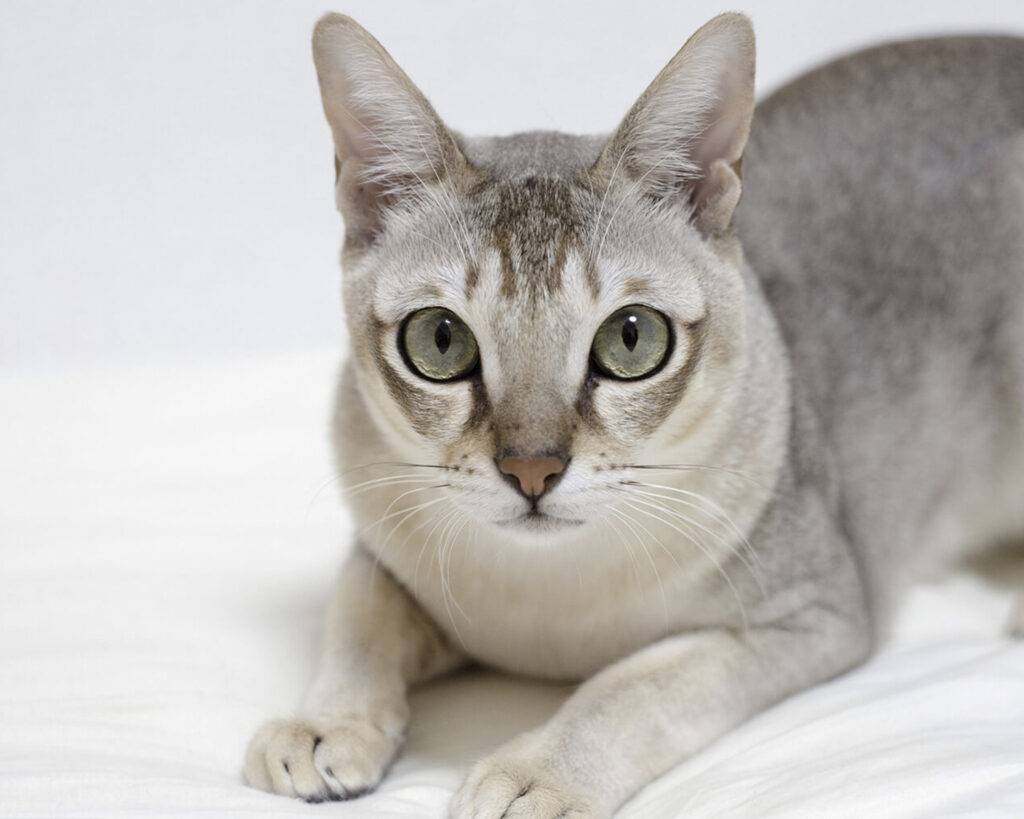
The Singapura is the smallest pedigreed cat in the world — a tiny, ticked-coated charmer with enormous almond eyes and an even bigger personality. Originally a humble street cat from Singapore, the breed has grown into a cherished companion known for its devotion, curiosity, and quiet, musical voice.
Key Takeaways
- The Singapura is the smallest recognized cat breed, with males rarely topping 8 pounds and females often weighing under 6.
- It comes in a single recognized color: sepia agouti, a warm ivory coat with dark-brown ticking on each hair.
- These cats are intensely people-oriented, playful, and curious, communicating through soft chirps and trills rather than loud meows.
- Grooming needs are low, but the short coat and small body mean Singapuras chill easily and appreciate warmth.
- Two inherited concerns — pyruvate kinase deficiency and uterine inertia — make buying from a responsible, screening breeder essential.
Quick Facts
| Origin | Singapore |
|---|---|
| Size | Small (males 6–8 lb / 2.7–3.6 kg, females 4–6 lb / 1.8–2.7 kg) |
| Coat | Short — sepia agouti (the only accepted color) |
| Body type | Semi-foreign |
| Lifespan | 11–15 years |
| Temperament | Active, curious, affectionate, playful |
| Activity level | High |
| Vocalization | Moderate |
| Grooming needs | Low |
| Good with children | Yes |
| Good with other pets | Yes |
| Hypoallergenic | No |
| Recognized by | TICA, CFA, FIFe, WCF |
Appearance


The Singapura is exceptionally small. Adult males rarely top 8 pounds, and females typically stay between 4 and 6 pounds, yet the body is solid and surprisingly muscular for its size. Anyone picking one up for the first time is struck by how dense and athletic the cat feels in hand.
The head is small and rounded, with a short, broad muzzle and well-defined whisker pads; males are permitted slightly fuller cheeks. The eyes are the breed’s signature feature: very large, almond-shaped, set wide apart, and rimmed in dark brown, in shades of green, gold, or hazel. The ears are large and gently cupped, and the tail is medium in length — slim but not whippy — finishing in a blunt tip. Paw pads are a pinkish brown.


The coat is short, fine, and lies very close to the body. Only one color is recognized: sepia agouti, a warm old-ivory ground tone overlaid with dark-brown ticking on each individual hair. The chest, belly, and inner legs stay plain ivory. A faint “M” marking sits on the forehead, and a darker dorsal line often runs along the spine to the tail tip.
Personality


Singapuras are extroverts in miniature. They bond intensely with their people, follow them from room to room, and insist on supervising every household activity, from answering email to making the bed. Owners often describe them as “pesky” in the most affectionate sense — a cat that is rarely far from your shoulder.
Beneath the cuddly exterior runs a true working cat’s curiosity. Singapuras are tireless climbers, openers of cupboards, and investigators of paper bags and laundry baskets. Their voice is soft and pleasant; they communicate through trills and gentle chirps rather than loud meowing.
For all their attachment, Singapuras keep a streak of independence and sharp hunting instincts — a holdover from their feral ancestry. They generally get along well with children, easygoing dogs, and other cats, particularly when raised together from kittenhood.


Health
Singapuras are small but generally hardy, with a typical life expectancy of 11 to 15 years and many individuals living comfortably beyond that. As with any breed, routine veterinary care goes a long way toward a long, healthy life, and a few inherited issues are worth knowing about.
- Pyruvate kinase deficiency (PKDef) — a red-blood-cell enzyme defect that can cause intermittent anemia. A simple DNA test exists, and reputable breeders screen all breeding cats so that affected kittens are not produced.
- Uterine inertia — an inability to push kittens out naturally. Singapura queens frequently require a planned Caesarean section, which is one reason litters are small and why breeding the cat responsibly is not a casual undertaking.
Because the coat is so short and the body so light, Singapuras chill quickly. Keep them out of drafty rooms and unheated spaces, and provide warm bedding in cooler months. Routine checkups, vaccinations, dental care, and parasite control round out their needs; for a general overview of preventive care, the ASPCA’s cat care guidance and the Cornell Feline Health Center are both reliable starting points.
Care


Singapuras are pleasingly low-maintenance to groom. A weekly once-over with a soft brush or rubber grooming mitt removes loose hair and keeps the coat glossy; during the spring shed, twice a week is plenty. Bathing is rarely needed unless the cat finds something genuinely dirty to roll in.
Pay regular attention to ears, nails, and teeth. Wipe the large ears with a vet-approved cleaner if wax builds up, trim the nails every two to three weeks, and brush the teeth with feline toothpaste several times a week to help ward off the dental disease that often shadows small-jawed breeds. The American Veterinary Medical Association offers practical owner guidance on home dental and routine care.
Feed a complete, balanced diet — wet, dry, or a mix — and measure portions carefully. Their tiny frames mean even modest overfeeding leads to obesity. Provide tall climbing furniture, puzzle feeders, and at least two daily play sessions; an under-stimulated Singapura is liable to become noisy or mischievous.
History

The Singapura takes its name from the Malay word for Singapore, where its ancestors lived as semi-feral street and drain cats — earning the local nickname “kucinta,” loosely translated as “love cat.” For decades these big-eyed brown cats were largely overlooked, but in 1971 the American geophysicist Hal Meadow brought several home from a work posting in the region. His wife, Tommy Meadow, began a deliberate breeding program in the mid-1970s, refining the type while preserving its natural look.
TICA accepted the breed in 1981, and the CFA granted championship status in 1988. The Singapura is now also recognized by FIFe and the World Cat Federation. Singapore itself has adopted the cat as a national emblem — a bronze sculpture of a Singapura stands on the bank of the Singapore River. Today the breed remains one of the rarest in the cat fancy, treasured for its compact size, sociable nature, and unmistakable ticked coat.
Registry Recognition
The Singapura is recognized by The International Cat Association (TICA), the Cat Fanciers’ Association (CFA), the Fédération Internationale Féline (FIFe), and the World Cat Federation (WCF) — first recognized in 1981.
Frequently Asked Questions
How big does a Singapura cat get?
The Singapura is the smallest recognized cat breed. Males generally weigh 6 to 8 pounds and females 4 to 6 pounds, yet the body is dense and muscular, so the cat feels heavier in hand than its size suggests.
Are Singapura cats hypoallergenic?
No. No cat breed is truly hypoallergenic, and the Singapura is no exception. Its coat is short and sheds little, which some allergy sufferers find easier to live with, but the cat still produces the Fel d 1 protein responsible for most reactions.
Are Singapuras good family pets?
Yes. They are affectionate, playful, and people-oriented, and they typically get along well with children, easygoing dogs, and other cats — especially when raised together from kittenhood. Their soft, chirpy voice also makes them quieter companions than many active breeds.
Why are Singapura cats so rare and expensive?
The breed has a small gene pool, and queens often need a planned Caesarean section because of uterine inertia, so litters are small and breeding is demanding. Responsible breeders also screen for pyruvate kinase deficiency, all of which keeps numbers low and prices high.
Health Watchlist
Conditions reported in the breed include pyruvate kinase deficiency (PKDef) and uterine inertia. Reputable breeders screen breeding cats and guarantee against early-onset hereditary disease — always ask to see the parents’ test results before adopting a kitten.