
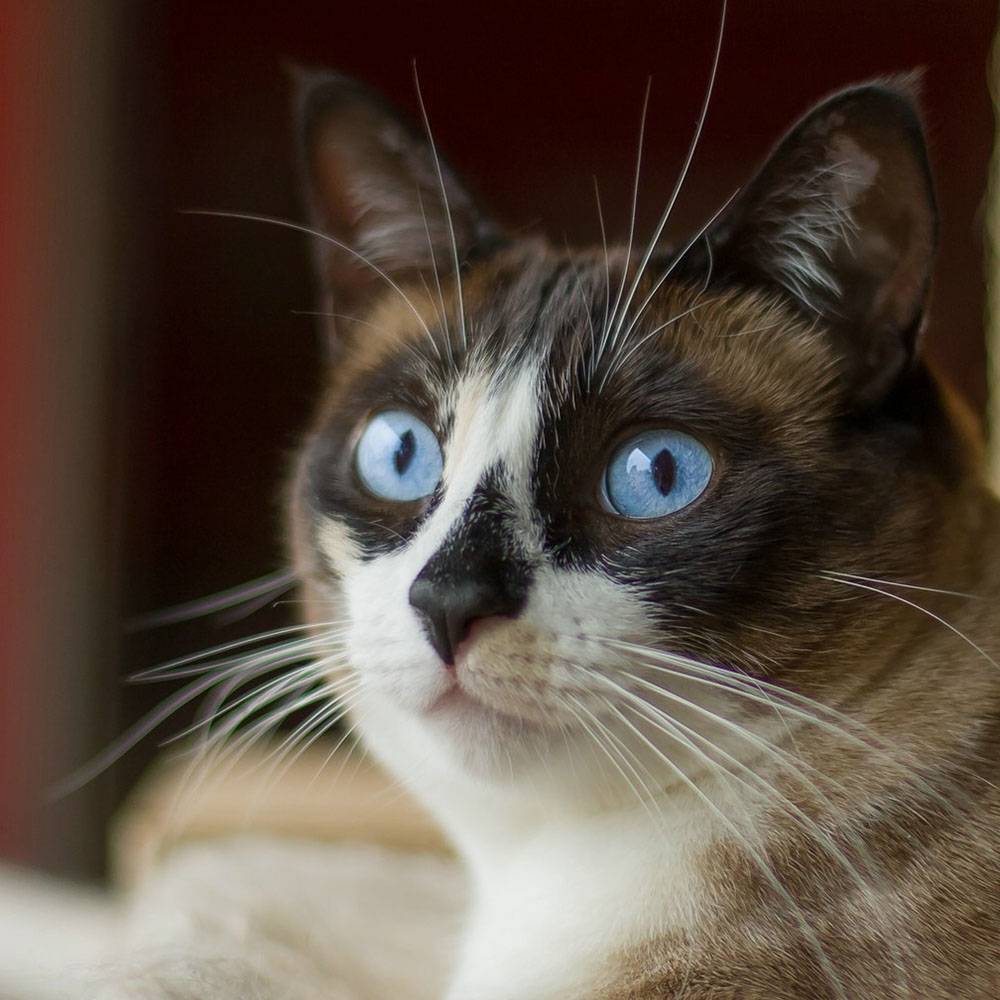
The Snowshoe is a striking medium-sized cat with bright sapphire-blue eyes, pointed coloring, and the four crisp white “boots” that gave the breed its name. Descended from the Siamese and the American Shorthair, it pairs the elegance and chatty nature of its Eastern ancestor with a calmer, steadier temperament, making it an affectionate family companion that gets along well with children, dogs, and other cats.
Quick Facts
| Origin | United States |
|---|---|
| Size | Medium (males 4.0–5.5 kg / 9–12 lb, females 3.0–4.5 kg / 7–10 lb) |
| Coat | Short, pointed with white feet and markings |
| Body type | Semi-foreign |
| Lifespan | 14–19 years |
| Temperament | Affectionate, vocal, intelligent, sociable |
| Activity level | Moderate |
| Grooming needs | Low |
| Good with children | Yes |
| Good with other pets | Yes |
| Hypoallergenic | No |
| Recognized by | TICA, FIFe, WCF |


Appearance
The Snowshoe is a moderately built, well-muscled cat with a balanced rectangular body that falls somewhere between the slender Siamese and the sturdier American Shorthair. Adult males typically weigh 4 to 5.5 kg (about 9 to 12 pounds) and females 3 to 4.5 kg (about 7 to 10 pounds). The head forms a softly rounded modified wedge, the ears are medium to large with rounded tips, and the slightly oval, deep-blue eyes are the breed’s signature feature. The legs are proportional to the body, and the tail tapers gently to the tip.
The coat is short, dense, and glossy, with very little undercoat. The color is always pointed, in the classic Siamese shades of seal point, blue point, chocolate point, or lilac point, with the points contrasting sharply against a paler body. The face usually carries a white inverted-V marking, and each foot ends in a clean white “sock.” In show-quality cats, all four white paws should be even in length and shape, which is one of the hardest traits to breed consistently.


Personality
Compared with the Siamese, the Snowshoe is calmer and more even-tempered without losing its love of company. These cats form strong bonds with their families, get along easily with children, and adapt well to homes that already include other cats or dogs. Many will choose a favorite playmate to chase around the house and then curl up with at the end of the day.
Snowshoes are sociable and conversational, though their voice is softer and less insistent than the classic Siamese yowl. They tend to greet visitors with curiosity rather than shyness, but they prefer to be invited onto a lap rather than scooped up by strangers. They can tolerate short stretches alone reasonably well, but they are social by nature and should not be left isolated for long stretches of the day. If you work long hours, a second pet for company is worth considering.


Health
The Snowshoe is generally a robust, long-lived breed, with a typical life expectancy of 14 to 19 years and no widespread hereditary disorders. The most commonly reported quirks are cosmetic traits inherited from the Siamese line: occasional crossed eyes (strabismus) and a kinked tail, neither of which affects quality of life. Routine veterinary check-ups, dental care, vaccinations, and parasite prevention are usually all that is needed to keep a Snowshoe in excellent condition throughout its life.
Dental health deserves special attention in any cat. According to the Cornell Feline Health Center, between 50 and 90 percent of cats over four years of age develop some form of dental disease, so regular tooth brushing and veterinary dental checks are an easy way to protect your cat’s long-term health.


Care
Caring for a Snowshoe is refreshingly straightforward. The short, low-shedding coat needs only a weekly once-over with a soft brush or grooming mitt to lift loose hair and keep it glossy. Trim the claws every two to three weeks, check the ears for wax buildup, and brush the teeth regularly to help prevent dental disease.
Snowshoes thrive on interaction, so plan for daily play sessions, climbing furniture, and puzzle feeders to keep their bright minds engaged. Feed a high-quality, complete diet appropriate to the cat’s age and activity level, and keep fresh water available at all times. For a general overview of feline husbandry, the ASPCA’s general cat care guidelines are a reliable starting point for new owners.
History
The Snowshoe was developed in the United States in the 1960s by Philadelphia breeder Dorothy Hinds-Daugherty, who set out to combine the pointed coloring of the Siamese with the white feet of bi-color American Shorthairs. By crossing Siamese cats with bi-color American Shorthairs and selecting for the desired markings, she fixed a new look that breeders gradually refined into a recognized breed.
Progress was slow because the precise white pattern is difficult to reproduce reliably, and interest nearly faded altogether before a new generation of enthusiasts revived the line in the 1980s. The Cat Fanciers’ Federation granted the Snowshoe championship status in that decade, and The International Cat Association (TICA) recognized it as a championship breed in 1994. The Snowshoe has since also been accepted by FIFe and the World Cat Federation. It remains relatively rare today, but devoted breeders maintain active programs across North America, Europe, and parts of Asia.


One last bit of trivia: the breed name is sometimes read literally as “snow boots,” a fitting nod to the four white feet that distinguish every well-marked Snowshoe.
Frequently Asked Questions
Are Snowshoe cats good family pets?
Yes. Snowshoes are affectionate, sociable cats that bond closely with their people and generally do well with children, dogs, and other cats. Their calmer temperament compared with the Siamese makes them a good fit for busy households, provided they get daily interaction and play.
Are Snowshoe cats vocal?
They are talkative, but their voice is softer and less piercing than the classic Siamese yowl. Most Snowshoes “chat” with their owners throughout the day rather than demand attention loudly, which many people find charming.
How big do Snowshoe cats get?
The Snowshoe is a medium-sized breed. Males usually weigh about 4 to 5.5 kg (9 to 12 pounds) and females about 3 to 4.5 kg (7 to 10 pounds), with a balanced, well-muscled build.
Are Snowshoe cats hypoallergenic?
No. Despite their short, low-shedding coats, Snowshoes are not hypoallergenic. No cat breed is truly allergen-free, since the main allergen (the Fel d 1 protein) is found in saliva and skin rather than the coat itself.
Are Snowshoe cats rare?
Yes, they remain relatively uncommon. The white markings are difficult to reproduce reliably, which has kept breeding numbers low. Dedicated breeders maintain programs in North America, Europe, and parts of Asia, but expect a waiting list if you want a well-marked kitten.