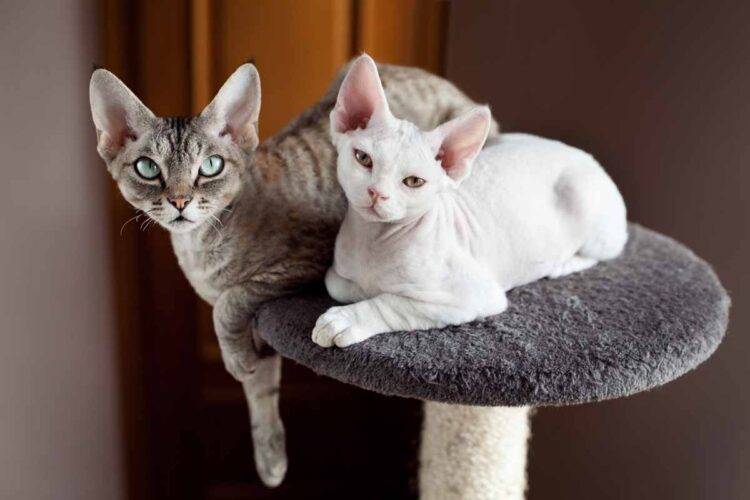
With a soft, lamb-like coat and oversized bat ears, the Devon Rex is one of the most distinctive cats in the world. Sociable, mischievous, and deeply attached to their people, these affectionate “pixie cats” fit easily into busy households and get along beautifully with children, other cats, and even dogs.
Quick Facts
| Origin | United Kingdom (Devon, England) |
|---|---|
| Size | Small to medium (about 6–9 lb / 2.3–4.5 kg) |
| Coat | Short, soft, wavy (“rexed”); all colors and patterns |
| Body type | Foreign (slender but muscular) |
| Lifespan | 9–15 years |
| Temperament | Mischievous, affectionate, active, playful |
| Activity level | High |
| Vocalization | Moderate (soft chirps and trills) |
| Grooming needs | Low |
| Good with children | Yes |
| Good with other pets | Yes |
| Shedding | Minimal (no cat is fully hypoallergenic) |
| Recognized by | TICA, CFA, FIFe, WCF |
Appearance
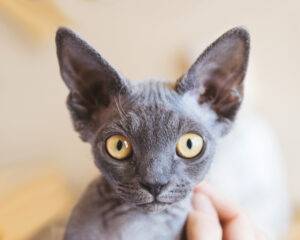
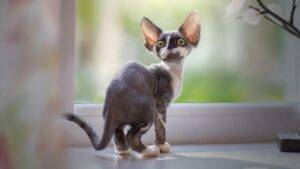
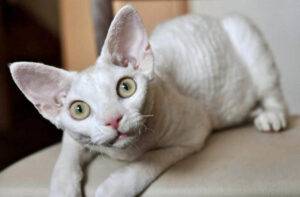
The Devon Rex is a small to medium-sized cat, with adults typically weighing between about 6 and 9 pounds (2.3–4.5 kg). Almost everything about this breed is unusual — from the oversized, low-set ears that resemble a bat’s wings to the soft, curly short coat that looks and feels like a lamb’s fleece. The Cat Fanciers’ Association describes the result as a distinctly “elfin look”.
The body is slender but surprisingly sturdy, with strong bones and well-developed muscles. The legs are long and slim, with the hind legs noticeably longer than the front, giving the Devon Rex a slightly raised stance. The head is compact and shaped like a short, blunt wedge.
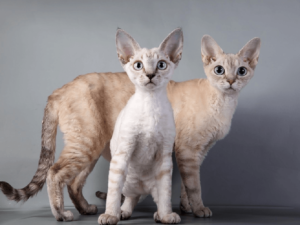
The muzzle is short with a clearly defined stop and well-marked cheekbones. The eyes are large, oval, and set wide apart, and their color usually harmonizes with the coat. Some cats display delicate lynx-like tufts at the tips of their wide-set ears. The tail is long, slim, and tapered, finishing in a fine point.
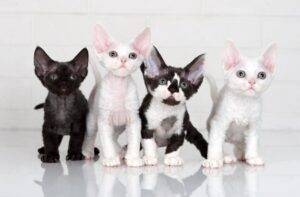
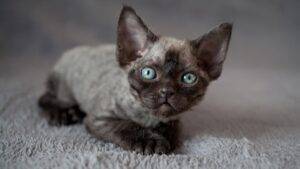
The fur is short, soft, and clearly waved across most of the body, while the belly is often covered only in a fine down. Every color and pattern is accepted by the breed standards, including solids, tabbies, bicolors, and pointed varieties.
Personality
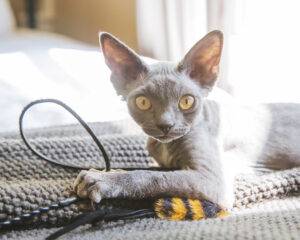
Although a touch calmer than its cousin the Cornish Rex, the Devon Rex is still famous for a lively, expressive temperament. These cats are curious, playful, and endlessly inventive — happy to chase a feather toy one minute and ride on your shoulder the next. The CFA memorably calls the Devon “part court jester, part soulmate”.
Devon Rex cats are intensely people-oriented. They bond deeply with their families, follow their favorite humans from room to room, and dislike being left alone for long stretches. They mix easily with other cats, get along with friendly dogs, and are usually very patient with children, making them an excellent choice for active households.
They are clever problem-solvers and can be taught simple tricks, to play fetch, and even to walk on a harness. Owners often describe them as kind, empathetic, and almost dog-like in their devotion. With their sparkling eyes and constantly flicking tail tips, Devon Rexes seem genuinely happy to share life with their humans.
Health
Because their thin coat offers little insulation, Devon Rex cats dislike cold weather and are best kept as indoor pets in a warm, draft-free home. Overall the breed is generally healthy, but a handful of inherited conditions are documented, including hypertrophic cardiomyopathy (HCM), patellar luxation, and a form of congenital muscle weakness known as Devon Rex myopathy. HCM is the most common heart disease in cats according to the Cornell Feline Health Center, and genetic factors are believed to play a significant role. Responsible breeders screen their breeding cats and provide written health guarantees, so always review the parents’ test results before bringing a kitten home.
With good care, regular veterinary checkups, and a balanced diet, the average life expectancy is 9 to 15 years.
Care & Grooming
The Devon Rex’s wavy coat needs only light grooming — a gentle weekly brushing with a soft brush, or a stroke with a damp hand, is usually enough to keep it looking neat. Brushing too hard can actually break the fragile hairs, so a light touch is best. Because shedding is minimal, the breed is often considered a good option for households sensitive to cat hair, although no cat is truly hypoallergenic.
An occasional bath with a mild, cat-safe shampoo helps remove the oils that can build up on the skin. Check the large ears every week, as wax tends to accumulate quickly; clean them carefully with a vet-approved ear-cleaning solution. Trim the claws every couple of weeks and brush the teeth regularly to help prevent dental disease.
Devon Rexes are highly active, so plenty of toys, climbing furniture, and daily interactive play are essential to keep them happy and out of mischief. They have hearty appetites for their size, so measured portions of high-quality food will help keep them in lean condition.
History
The Devon Rex’s story begins in the United Kingdom. In 1960, in the county of Devon, a stray cat gave birth to a litter that included a single curly-coated kitten named Kirlee. Local cat lover Beryl Cox took him in and, intrigued by his unusual coat, decided to investigate whether the trait could be reproduced.
Kirlee was first paired with Cornish Rex queens, but the resulting kittens all had straight coats. This proved that the Devon’s curl was caused by a different recessive gene than the Cornish Rex mutation discovered a decade earlier. Breeders in England, the United States, and France then carefully outcrossed Kirlee’s descendants with various other cats to expand the gene pool.
FIFe granted the new breed official recognition in 1967. In the United States, the Devon and Cornish Rex were initially considered the same breed, but their differences were formally recognized in 1979. TICA accepted the modern Devon Rex breed standard in 1988, and today the breed is recognized by all major international cat registries, including the CFA, TICA, FIFe, and the World Cat Federation.
Frequently Asked Questions
Are Devon Rex cats hypoallergenic?
Not entirely. Devon Rexes shed very little and have a short, fine coat, which means they spread less loose hair around the home. However, cat allergies are triggered mainly by a protein in saliva and skin (Fel d 1), not by hair length, so no cat — including the Devon Rex — is fully hypoallergenic. Many allergy-sensitive owners still tolerate the breed well, but it is wise to spend time with a Devon before committing.
Do Devon Rex cats get cold easily?
Yes. Their thin, sparse coat provides little insulation, so Devon Rexes seek out warm spots and can be uncomfortable in cold or drafty rooms. They are best kept as indoor cats in a heated home, and many happily burrow under blankets or curl up against their owners for warmth.
How much grooming does a Devon Rex need?
Very little. A gentle weekly wipe with a damp hand or a soft brush is usually enough, since vigorous brushing can break the delicate hairs. The main grooming priorities are cleaning their large ears, which build up wax quickly, plus routine nail trims and dental care.
Are Devon Rex cats good with children and other pets?
Generally, yes. Devon Rexes are sociable, patient, and people-oriented, which makes them a good fit for families with children and for homes with friendly dogs or other cats. As with any pet, interactions between young children and cats should always be supervised.
How long do Devon Rex cats live?
With good nutrition, regular veterinary care, and an indoor lifestyle, Devon Rex cats typically live 9 to 15 years. Choosing a kitten from a breeder who screens for inherited conditions such as HCM gives the best chance of a long, healthy life.

Recent Comments