Key Takeaways
- The major cat registries officially recognize roughly 40 to 75 breeds, and the exact count depends on which organization you ask.
- The Cat Fanciers’ Association (CFA) recognizes around 45 breeds, while The International Cat Association (TICA) lists more than 70.
- Most cats in the world belong to no formal breed at all — they are simply Domestic Shorthairs and Domestic Longhairs.
- Terms like “tabby” describe a coat pattern, not a breed, and no cat breed is truly hypoallergenic.
Picture yourself standing in an animal shelter. Dozens of eyes look back at you — striped, jet-black, long-haired, even completely bald. Almost everyone who spends a few minutes there ends up asking the same thing: how many cat breeds are there in the world? The honest answer is both simple and surprisingly complicated.
Feline registries — the professional organizations that catalog and classify domestic cats — officially recognize somewhere between roughly 40 and 75 breeds. The exact figure depends on which association you trust. The Cat Fanciers’ Association (CFA) recognizes just over forty, while The International Cat Association (TICA) lists more than seventy.
And that’s only the official record. Beyond the catalogs and the competition rings, hundreds of regional lines, naturally occurring populations, and developing breeds also exist. New cat breeds continue to emerge, evolving right alongside the people who live with them.
How Many Cat Breeds Are There Today?
Ask a professional breeder or a felinologist this question and the answer usually comes with a pause — not twenty, not a hundred. Today, somewhere between about 45 and 73 recognized breeds appear across the major international registries. The reason for that wide spread is straightforward: each organization applies slightly different classification rules. Some recognize a new breed fairly quickly once its genetics are stable; others insist on long evaluation periods before granting full status.
Here is how the numbers tend to break down across the largest registries:
| Organization | Recognized cat breeds |
|---|---|
| CFA | ~45 |
| TICA | ~73 |
| FIFe | ~50 |
| WCF | ~60 |
One detail explains much of the confusion: the same breed can appear under slightly different standards depending on the registry, and closely related regional variations are sometimes folded together under a single name. What one organization counts as two breeds, another may count as one.
There’s another fact that surprises people. The overwhelming majority of cats in the world don’t belong to any official breed at all. They’re commonly called Domestic Shorthairs or Domestic Longhairs — natural populations rather than deliberately developed breeds. That doesn’t make classification pointless, though. A recognized breed gives owners reliable clues about temperament, coat type, grooming needs, and behavior, which is exactly why so many families look for one. For practical guidance on caring for any cat, breed or not, the ASPCA’s cat care resources are a dependable starting point.
How Scientists Classify the Different Types of Cats
There is an entire field of study devoted to cats. It’s called felinology — the study of domestic cats, their genetics, breeding patterns, behavior, and physical structure. Felinologists generally classify the different types of cats using several key criteria:
- coat length and texture
- color genetics
- body structure
- geographic origin
- unique mutations affecting fur or bone structure
Genetics plays the central role in all of this. A single mutation can completely transform the way a cat looks, and many modern breeds came into existence simply because someone noticed an unusual kitten and decided to develop the trait. A few well-known examples make the point. The Scottish Fold descends from a mutation affecting the cartilage in its ears, which is why those ears fold forward and down. The Sphynx, the most famous hairless cat breed, emerged from a gene that alters hair-follicle development. And the Selkirk Rex, one of the rare curly-coated breeds, resulted from a mutation that produces soft, wavy fur.
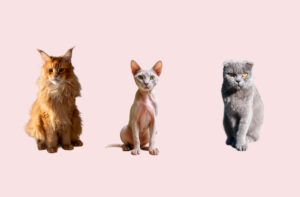
What makes feline genetics so fascinating is how often these traits show up spontaneously. A curly-coated kitten can appear in an otherwise ordinary litter; a hairless kitten can be born to two fully coated parents. When breeders recognize a trait worth preserving, they sometimes build an entirely new breed around it.
The Biggest Cat Breed and Other Giant Domestic Cats
Some people just want a cat. Others want something a little more dramatic — a feline that looks almost like a small wild predator padding through the living room. That’s where the Maine Coon enters the conversation.
The Maine Coon is widely considered the biggest domestic cat breed. Adult males frequently weigh between 8 and 11 kilograms (roughly 18 to 24 pounds), and some grow larger still; from nose to tail tip, their bodies can stretch close to a meter. The breed developed naturally in the cold climate of Maine and picked up several useful adaptations along the way: a thick, water-resistant coat, large paws built for walking on snow, a powerful bone structure, and a long, bushy tail it can wrap around itself for warmth.
The Maine Coon isn’t the only gentle giant, though. Other notably large breeds include the Norwegian Forest Cat, the Ragdoll, the Siberian, and the Savannah.

The Savannah is especially unusual. It’s a hybrid between a domestic cat and the African serval, a wild species, and that wild heritage shows. Some Savannahs reach 12 to 14 kilograms and stand surprisingly tall for a house pet, often looking like a miniature cheetah. Because of their wild ancestry, ownership of certain Savannah generations is restricted or banned in some U.S. states, so it’s worth checking local regulations before falling in love with one.
Hairless Cat Breeds: Understanding the Genetics
Hairless cats tend to catch people off guard. Their skin looks wrinkled, their ears seem oversized, and their bodies feel unusually warm to the touch. The most famous example is the Sphynx, easily the best-known hairless cat breed.
Here’s a detail that surprises most newcomers: Sphynx cats aren’t actually bald. They carry a very fine layer of fuzz known as vellus hair — much like the soft, peach-like down on human skin. The genetic mechanism behind their “hairlessness” is a mutation that affects hair-follicle formation. The follicles still exist; they simply produce extremely short, fragile hairs. Because they lack a protective coat, hairless breeds need extra care — regular bathing to manage skin oils, sun protection, and warmth in cold weather. The Cornell Feline Health Center is a reliable source for understanding the health needs that come with these and other breeds.
Several other hairless breeds developed independently in different parts of the world, including the Donskoy, the Peterbald, and the Ukrainian Levkoy.
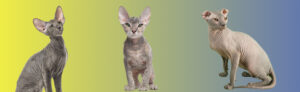
Each of these breeds arose in a different region through a different mutation, yet they share a strikingly similar appearance. It’s one of the clearest illustrations of how genetic variation can produce entirely new types of cats from separate starting points.
Curly Cat Breeds: The Rare Rex Cats
Curly fur in cats is genuinely rare. When it does appear, breeders often refer to the resulting animals as Rex cats — a catch-all term for the genetic mutations that affect coat structure. Instead of typical straight fur, the hairs grow in twisted or wavy patterns. Several well-known curly breeds belong to this group:
- Devon Rex
- Cornish Rex
- Selkirk Rex
- LaPerm
Each one has a slightly different genetic story behind the curls. The Selkirk Rex carries a dominant gene for its wavy coat, so a kitten needs only one copy to display the trait. The Cornish Rex and Devon Rex, by contrast, rely on different recessive mutations, which means both parents have to contribute the gene. The end result, in every case, is a cat whose coat looks almost like a soft cloud — widely regarded as some of the most charming in the feline world.
What Breed Is a Tabby Cat?
This is one of the most common misunderstandings among cat owners, so let’s clear it up: a tabby cat is not a breed. The word “tabby” describes a coat pattern, not a genetic lineage. The classic tabby look usually includes stripes running along the body, swirled or marbled markings, rings on the tail, and a distinctive “M” shape on the forehead.
These markings show up across dozens of breeds, including the Maine Coon, American Shorthair, Bengal, British Shorthair, and Siberian. So when someone asks “what breed is a tabby cat?”, the accurate answer is simple: tabby is the pattern, not the breed.
What Cat Breeds Are Hypoallergenic?
Plenty of people shopping for a new pet want to know which cat breeds are hypoallergenic. The idea is appealing — a cat that doesn’t set off allergies — but the science is more nuanced than the marketing suggests.
Most allergic reactions to cats are triggered by a protein called Fel d 1, which is produced in saliva and skin glands. When a cat grooms itself, the protein spreads onto the fur and eventually drifts into the air. Some breeds appear to produce lower levels of Fel d 1, including the Siberian, Balinese, Devon Rex, Cornish Rex, and Sphynx.
Does a lower-shedding or lower-Fel d 1 breed guarantee a reaction-free home? Unfortunately, no. There is no truly hypoallergenic cat, but many allergy sufferers report milder symptoms with these breeds than with others. If allergies are a concern, the American Veterinary Medical Association recommends spending time around a specific cat before committing to it.
The Most Common Cat Breeds in the World
Popularity among cat breeds shifts over time. Cultural trends, movies, social media, and breeding programs all nudge public taste in one direction or another. Even so, a handful of breeds consistently rank among the most common worldwide:
- Persian
- Maine Coon
- Ragdoll
- British Shorthair
- Siamese
- Bengal
The British Shorthair, for instance, became a household name thanks to its plush coat, round face, and easygoing personality. Internet culture played its part too — photos of these cats spread far and wide online, cementing their reputation as one of the most irresistibly cute breeds around.
The Most Expensive Cat Breed
Prices for cats span an enormous range. An adoption fee from a shelter might run less than a hundred dollars, while a pedigreed kitten from a professional breeder can climb into the thousands. Among the most expensive breeds, one name reliably sits at the top: the Savannah.
| Cat breed | Typical price |
|---|---|
| Savannah | $10,000–$20,000 |
| Bengal | $5,000+ |
| Persian | $3,000 |
| Peterbald | $4,000 |
Savannahs command those prices largely because of their hybrid origin. Breeding them requires careful genetic management and specialized knowledge, and the early generations in particular are difficult to produce. Add in the strong demand for their wild, exotic appearance, and the price tag starts to make sense.
The Best Cat Breeds for Families
Choosing the best cat for your home usually comes down to lifestyle rather than looks. Families with children tend to favor breeds known for patience, gentle behavior, and adaptability. A few names come up again and again in recommendations for busy households:
- Ragdoll — calm, affectionate, and remarkably tolerant
- Maine Coon — friendly and playful
- British Shorthair — a steady, balanced temperament
- Birman — highly social and people-oriented
- Siberian — energetic but deeply affectionate
Breeds like these tend to settle into family life with little friction, interacting easily with children and rolling with the noise and movement of a full household. Temperament does vary from cat to cat, of course, so meeting an individual animal still matters more than its breed on paper.
Black Cat Breeds: Myths and Reality
Black cats carry a long and tangled history in human culture. In medieval Europe they were sometimes tied to superstition; today they’ve earned a devoted following among cat lovers. The phrase “black cat breed” can be a little misleading, though, because many breeds are capable of producing a solid black coat — among them the Bombay, Persian, British Shorthair, and Maine Coon.
The Bombay is the closest thing to a dedicated black breed. It was developed specifically to resemble a miniature panther, and its glossy black coat paired with copper-colored eyes pulls off that effect remarkably well.
Cute Cats: Why Certain Breeds Look Irresistible
People often describe kittens simply as “cute cats.” But what is it, exactly, that makes a cat look cute? Behavioral scientists who study how we perceive animals point to the baby schema effect — a cluster of physical traits that humans instinctively read as adorable. These include large, round eyes, short noses, round faces, and soft fur.
Several breeds display those features in abundance, including the Persian, Scottish Fold, British Shorthair, and Ragdoll. The traits tap directly into our nurturing instincts, which is one of the quiet reasons cats became such successful companion animals in the first place.
The world of cats is far richer than most people realize. Breeds emerge, evolve, and occasionally fade away; genetics, selective breeding, and spontaneous mutation all feed that diversity. Today the international organizations recognize several dozen breeds, and tomorrow that number may well grow. Whether you’re drawn to the largest cat breed, intrigued by a mysterious hairless one, or simply hunting for a cute companion to share your home, one thing stays true: cats have mastered the art of living beside humans, and they keep finding ways to surprise us.
Frequently Asked Questions
How many cat breeds are officially recognized?
It depends on the registry. The CFA recognizes around 45 breeds, TICA lists more than 70, and other organizations such as FIFe and the WCF fall somewhere in between. There is no single universal number because each association uses its own classification rules.
Is a tabby cat a breed?
No. “Tabby” refers to a coat pattern — stripes, swirls, tail rings, and the signature “M” on the forehead — not a breed. The pattern appears across many breeds, from Maine Coons to Bengals, as well as in mixed-breed cats.
Are any cat breeds truly hypoallergenic?
Not entirely. Every cat produces the Fel d 1 protein responsible for most allergic reactions, though some breeds, such as the Siberian, Balinese, and Sphynx, appear to produce less of it. Many allergy sufferers report milder symptoms with these breeds, but none are guaranteed to be reaction-free.
What is the biggest domestic cat breed?
The Maine Coon is generally considered the largest domestic breed, with adult males often weighing 8 to 11 kilograms and bodies that can stretch nearly a meter from nose to tail. The Savannah, a domestic-and-serval hybrid, can be heavier still in its early generations.
What is the most expensive cat breed?
The Savannah typically tops the list, with kittens often priced from $10,000 to $20,000 depending on generation. Its high cost reflects the difficulty of breeding a domestic-wild hybrid and the strong demand for its exotic appearance.

Recent Comments