
The Maine Coon is the original gentle giant of the cat world: a friendly, highly intelligent, and strikingly large cat known for the lynx-like tufts on its ears and a thick, weatherproof coat. Despite its size, the breed is celebrated for a sweet, easygoing temperament and an effortless way with children, dogs, and other cats. Those qualities have helped make it one of the most popular pedigreed breeds in the United States and around the world.
Key Takeaways
- The Maine Coon is one of the largest domestic cat breeds, with males often reaching 13 to 18 pounds and a body that keeps developing until three or four years of age.
- It is affectionate and “dog-like,” communicating in soft chirps and trills rather than typical meows, and it generally thrives in busy, social households.
- The breed is genetically hardy but carries a known risk of hypertrophic cardiomyopathy (HCM); responsible breeders screen parent cats with DNA tests and cardiac ultrasound.
- Grooming is moderate — a thorough comb-out two to three times a week prevents mats in the longer fur.
Quick Facts
| Origin | United States (Maine) |
|---|---|
| Size | Large — males 13–18 lb (5.9–8.2 kg), females 8–12 lb (3.6–5.4 kg) |
| Coat | Semi-long; nearly all colors and patterns except pointed, chocolate, and lilac |
| Body type | Substantial, long, and muscular |
| Lifespan | 12–15 years |
| Temperament | Gentle, friendly, intelligent, playful |
| Activity level | Moderate |
| Vocalization | Moderate (chirps and trills) |
| Grooming needs | Moderate |
| Good with children | Yes |
| Good with other pets | Yes |
| Hypoallergenic | No |
| Recognized by | TICA, CFA, FIFe, WCF |
Appearance

The Maine Coon is among the largest domestic cat breeds. Adult males typically weigh 13 to 18 pounds, with females noticeably smaller at 8 to 12 pounds. The body is long, rectangular, and muscular, set on sturdy bone with broad shoulders. For all that bulk, Maine Coons move with surprising grace.
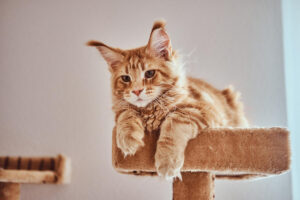
The head is slightly longer than it is wide, with high cheekbones, a square muzzle, and a firm chin. The ears are large, wide at the base, set high on the head, and finished with the breed’s signature lynx tips and ear furnishings. The eyes are large, oval, and set at a slight slant; any eye color is allowed and is independent of coat color.

The coat is semi-long, dense, and water-resistant, with a silky texture, a heavy ruff around the neck, britches on the hind legs, and tufts between the toes — all adaptations to the cold New England winters in which the breed developed. The tail is long, wide at the base, and tapered to a point, carried like a plume. Nearly every color and pattern is accepted in the breed standard, with the exception of pointed, chocolate, and lilac.
Personality

Maine Coons are often described as “dog-like” in their devotion. They form strong bonds with their families, follow their people from room to room, and frequently greet visitors at the door. Affectionate as they are, they tend not to be clingy — most would rather be near you than draped on top of you.
This is an intelligent, playful breed that keeps its kitten-like enthusiasm well into adulthood. Maine Coons enjoy puzzle toys, games of fetch, and learning simple tricks, and many take readily to harness training or clicker work. Their voices are distinctive, too: rather than a typical meow, they tend to communicate in soft chirps and trills.
The breed is famously gentle. Maine Coons generally get along well with children, dogs, and other cats, and their patient, even-tempered manner makes them excellent companions for active families. Many are also fascinated by water and will paddle in sinks, drink from running taps, or turn up at bath time.
Health

Because the breed developed largely through natural selection on New England farms, Maine Coons enjoy a relatively robust gene pool and an average lifespan of 12 to 15 years. They are not, however, free of inherited disease, and responsible breeding calls for DNA and cardiac ultrasound screening of the parent cats.
The condition to know most about is hypertrophic cardiomyopathy (HCM), the most common form of heart disease in cats. A Maine Coon–specific mutation in the MYBPC3 gene has been identified, and reputable breeders screen for it. According to the Cornell Feline Health Center, HCM causes a thickening of the heart muscle and is the most commonly diagnosed cardiac disease in cats. Hip dysplasia also appears more often in this breed than in most cats, largely because of its size, and DNA tests are available for spinal muscular atrophy (SMA) and pyruvate kinase deficiency (PKDef) as well. Always ask to see current test results for both parents before bringing a kitten home.
Routine preventive care — annual veterinary exams, vaccinations, parasite control, and dental care — is essential. Because Maine Coons grow slowly and do not reach full size until three to four years of age, feeding and exercise during the juvenile years should support steady, lean development rather than rapid growth.
Care
The semi-long coat is surprisingly low-maintenance for its length, but it still needs regular attention. Brushing two to three times a week with a wide-toothed comb or slicker brush prevents mats, especially behind the ears, in the armpits, and around the britches. Step up to daily grooming during the heavy spring and autumn sheds.
Feed a high-quality, protein-rich diet suited to your cat’s age and activity level. Maine Coons have hearty appetites and can put on weight if free-fed, so portion-controlled meals and a measured amount of treats go a long way toward keeping a healthy body condition. Provide fresh water at all times — many Maine Coons drink more readily from a pet fountain.
This is an active breed that benefits from a tall cat tree, sturdy scratching posts, and daily interactive play. A few care basics are worth putting on a schedule:
- Trim the claws every two to three weeks.
- Brush the teeth as often as possible, ideally daily, to support dental health.
- Check the ears weekly for wax buildup and clean only as needed.
- Provide climbing and perching space rated for a large cat, so your Maine Coon can survey its territory from up high.
History

The Maine Coon is one of the oldest natural breeds in North America and the official state cat of Maine. Its true origins are unknown, but the most plausible theory is that long-haired cats brought to New England by European sailors in the 1700s and 1800s interbred with local short-haired farm cats, with the harsh climate favoring size, dense coats, and tufted feet. The Cat Fanciers’ Association notes that the Maine Coon is one of the oldest natural breeds in North America and a longtime fixture of New England.
Folklore offers more colorful explanations, including the popular but fanciful tale that the breed descends from Marie Antoinette’s Angora cats, supposedly shipped to Maine ahead of her failed escape during the French Revolution. Another long-discredited story credits a cross between a domestic cat and a raccoon — biologically impossible, but the likely source of the “Coon” in the breed’s name.

Maine Coons were prized as working cats on farms and ships throughout the 19th century and appeared at some of the earliest American cat shows; a brown tabby named Cosey won Best in Show at the 1895 Madison Square Garden show. The arrival of the Persian pushed the breed into the background for several decades, and by the mid-20th century the Maine Coon was thought to be near extinction.
A revival began in the 1950s, led by dedicated breeders who founded the Central Maine Coon Cat Club. The Cat Fanciers’ Association granted full championship status in 1976, and today the Maine Coon is one of the most popular pedigreed cats in the world, recognized by every major registry, including The International Cat Association (TICA).
Registry Recognition
The Maine Coon is recognized by The International Cat Association (TICA), the Cat Fanciers’ Association (CFA), the Fédération Internationale Féline (FIFe), and the World Cat Federation (WCF), which first recognized the breed in 1908.
Frequently Asked Questions
How big do Maine Coons get?
Maine Coons are one of the largest domestic cat breeds. Males commonly weigh 13 to 18 pounds and females 8 to 12 pounds, and they continue filling out until roughly three to four years of age. Their long, plumed tails and dense coats can make them look even larger than they are.
Are Maine Coons good family pets?
Yes. The breed is known for being gentle, patient, and sociable, and Maine Coons typically get along well with children, dogs, and other cats. Their affectionate, “dog-like” nature makes them a strong fit for active, busy households.
Are Maine Coons hypoallergenic?
No. No cat breed is truly hypoallergenic, and the Maine Coon’s thick, semi-long coat is no exception. People with cat allergies usually react to the Fel d 1 protein in saliva and dander rather than to fur length, so a Maine Coon is not a reliable choice for allergy sufferers.
What health problems are Maine Coons prone to?
The most notable concern is hypertrophic cardiomyopathy (HCM), a heart disease for which a breed-specific DNA test exists. Maine Coons can also be affected by hip dysplasia, spinal muscular atrophy (SMA), and pyruvate kinase deficiency (PKDef). Buying from a breeder who screens both parents and discussing routine cardiac monitoring with your veterinarian are the best ways to manage these risks.
How much grooming does a Maine Coon need?
Grooming needs are moderate. A thorough comb-out two to three times a week keeps the coat free of mats, with extra attention behind the ears, in the armpits, and around the britches. Brush daily during the heavy spring and autumn shedding seasons.

Recent Comments